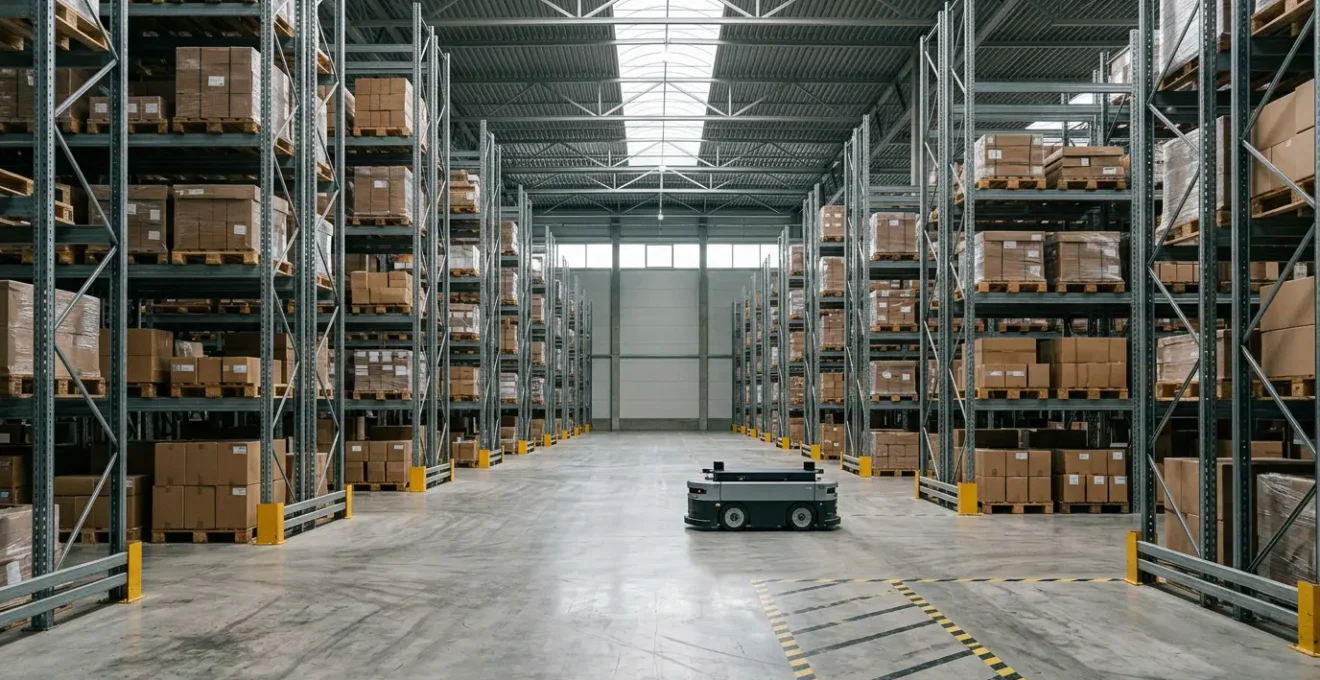
The AGV vs. AMR debate misses the point; the success of your automation project depends on what you do before the first robot arrives, not just which one you choose.
- Infrastructural weaknesses like poor Wi-Fi coverage and uneven floors are the primary cause of deployment failure, not the robots themselves.
- True throughput gains come from AI-driven fleet management, which optimizes total travel time, rather than the top speed of a single unit.
Recommendation: Begin with a thorough audit of your facility’s operational readiness, focusing on network, floor quality, and WMS data integrity, before engaging with robot vendors.
For any warehouse manager grappling with unpredictable demand and a shrinking labor pool, the question is no longer *if* you should automate, but *how*. The conversation inevitably starts with a comparison: Automated Guided Vehicles (AGVs) versus Autonomous Mobile Robots (AMRs). AGVs are the reliable workhorses, following fixed magnetic tape or wired paths, perfect for predictable, repetitive tasks. AMRs are the intelligent navigators, using advanced technologies like SLAM (Simultaneous Localization and Mapping) to dynamically route around obstacles, adapting to the chaos of a modern facility.
The common wisdom suggests a simple choice: AGVs for static environments, AMRs for dynamic ones. But this binary view is dangerously simplistic. It overlooks the fundamental truth that many high-potential automation projects fail to prove their ROI at scale. The critical failure point is rarely the robot itself. It’s the environment it’s deployed into. Before you can truly evaluate which robot is “best,” you must first diagnose your warehouse’s operational readiness. The most advanced AMR in the world is useless if it’s crippled by Wi-Fi dead zones or confused by inaccurate inventory location data.
This article reframes the debate. Instead of a simple feature comparison, we will explore the critical operational layers that determine success or failure. We will delve into the root causes of the labor crisis, the non-negotiable prerequisites for mapping your facility, the hidden safety flaws to be aware of, and how to leverage AI to truly optimize your fleet. This is not just a guide to choosing a robot; it’s a playbook for building an ecosystem where automation can actually thrive.
To navigate these critical considerations, this guide is structured to address the most pressing operational questions warehouse managers face when planning an automation strategy. Explore the sections below to build a comprehensive understanding of what it takes to succeed.
Summary: A Manager’s Guide to Warehouse Automation Readiness
- Why Warehouses Can’t Find Workers Even with Higher Wages?
- How to Map Your Warehouse for Autonomous Robots in 1 Week?
- The Safety Sensor Flaw That Causes Robot-Human Collisions
- Lidar vs QR Codes: Which Navigation System Requires Less Maintenance?
- How to Use AI to Reduce Robot Travel Time by 20%?
- Why 80% of Emerging Tech Implementations Fail at Scale?
- Why Overlaying Schematics on Reality Reduces Assembly Errors?
- Drone Delivery: Is It Legally Feasible for Your Local Business Yet?
Why Warehouses Can’t Find Workers Even with Higher Wages?
The narrative that higher wages will solve the warehouse labor shortage is proving to be a fallacy. While competitive pay is a factor, it fails to address the core issues driving workers away from the industry: the punishing physical demands and the resulting high risk of injury. The work is strenuous, repetitive, and takes a significant toll on the human body over time. This isn’t just an anecdotal observation; it’s a stark statistical reality that managers must confront.
The physical strain manifests in alarming injury rates. For instance, according to the U.S. Bureau of Labor Statistics, the transportation and warehousing industry had an incidence rate of 77.1 musculoskeletal disorder (MSD) cases per 10,000 full-time workers. These injuries, including sprains, strains, and carpal tunnel syndrome, are a direct result of the repetitive lifting, bending, and reaching inherent in many manual warehouse tasks. The high turnover rates, sometimes exceeding 150% at major industry players, are not just about workers chasing a slightly higher hourly wage; they are about self-preservation.
This creates a vicious cycle: a constant need to recruit and train new employees who, in turn, face the same physical risks and are likely to leave. Automation with AGVs and AMRs offers a direct solution by taking over the most physically demanding and repetitive tasks. By deploying robots for long-distance transport, heavy lifting, and repetitive put-away tasks, you don’t just fill a labor gap—you fundamentally change the nature of the remaining human jobs, making them safer, less physically taxing, and more focused on value-added activities. This is the key to creating a more stable and sustainable workforce.
How to Map Your Warehouse for Autonomous Robots in 1 Week?
The promise of AMRs lies in their ability to navigate freely, but this “freedom” is entirely dependent on a highly accurate digital map of your facility. Creating this map, a process often utilizing SLAM technology, is the foundational step of any successful deployment. While some vendors claim this can be done rapidly, the “1-week” timeline is only achievable if critical prerequisite work has been completed. The quality of the map—and therefore the performance of your entire fleet—is built on the quality of your existing infrastructure.
At the heart of modern mapping is a sensor technology like LiDAR (Light Detection and Ranging), which uses laser pulses to measure distances and create a precise, 3D point cloud of the environment. The AMR’s software then uses this data to build a digital twin of the warehouse, which it uses for real-time localization and path planning. Ignoring the foundational work is a recipe for perpetual performance issues, where robots get lost, hesitate, or take inefficient routes.
As the image highlights, the precision of these sensors is remarkable, but they are only as good as the environment they read. Before a single robot begins its mapping run, your facility must be prepared. This involves a series of checks that are often overlooked in the rush to deploy. The following checklist outlines the non-negotiable steps to ensure your mapping process is fast and, more importantly, effective.
Your Action Plan: Warehouse Readiness Checklist for Robot Mapping
- Wi-Fi Site Survey: Conduct a comprehensive survey to identify and eliminate all connectivity dead zones that could disrupt robot communication and real-time localization.
- Floor Quality Assessment: Systematically identify and document cracks, significant inclines, and surface irregularities that can interfere with navigation accuracy and cause odometry errors.
- WMS Data Cleansing: Before mapping, ensure all location data within your Warehouse Management System (WMS) is pristine and accurate to prevent robots from going to non-existent or incorrect locations.
- Hardware/Software Compatibility Check: Verify that your chosen AMR’s software is fully compatible with its onboard camera hardware and SLAM algorithms to ensure reliable system performance.
- SLAM Methodology Selection: Choose the right mapping strategy (Teach & Repeat, SLAM Exploration, or CAD File Import) based on whether you are in a brownfield (existing) or greenfield (new) facility.
The Safety Sensor Flaw That Causes Robot-Human Collisions
In a dynamic warehouse where humans and robots share the same floor space, safety is not just a feature—it’s the bedrock of the entire operation. Modern AMRs are equipped with a sophisticated array of sensors, including LiDAR and 3D cameras, designed to detect and avoid obstacles, especially people. However, a critical and often misunderstood “flaw” exists not in the sensors themselves, but in their configuration and the inherent limitations of their detection zones. This can lead to dangerous low-speed collisions, particularly with feet and lower legs.
The core of the issue lies in the robot’s “safety field,” a 2D horizontal plane scanned by the primary safety LiDAR. International safety standards like ISO 3691-4 require PLd-rated systems (a high measure of reliability under ISO 13849) for personnel detection. This primary sensor is typically mounted low to the ground to detect obstacles in the robot’s direct path. However, this creates a potential blind spot. If a person steps very close to the robot, their feet can enter the space *underneath* the upper 3D camera’s field of view but *inside* the safety LiDAR’s immediate stopping zone, where the robot might not have time to react before a low-impact contact occurs.
Furthermore, the robot’s protective field is often configured in zones: a wider “warning” field where it slows down, and a tighter “stop” field where it halts completely. A fast-moving person or a forklift can cross from the warning to the stop field too quickly for the robot to come to a complete standstill, resulting in a collision. The “flaw” is therefore a combination of sensor blind spots, speed/braking distance calculations, and human unpredictability. Mitigating this requires more than just good sensors; it demands intelligent fleet management that reduces speeds in congested areas, clear floor markings for pedestrian walkways, and rigorous training for all staff on how to interact safely with their robotic counterparts.
Lidar vs QR Codes: Which Navigation System Requires Less Maintenance?
Once you move past the AGV vs. AMR distinction, the next critical decision point is the navigation technology itself. For a manager focused on operational uptime and total cost of ownership, the maintenance burden is a deciding factor. The primary contenders are LiDAR-based SLAM, used by most AMRs, and floor-based markers like QR codes or magnetic tape, a hallmark of many modern AGVs. While QR codes may seem simpler and cheaper upfront, they often carry a hidden, relentless maintenance cost.
A system based on floor markers requires constant physical upkeep. Forklift tire marks, dust, debris, or damage from pallet scraping can obscure a QR code or magnetic stripe, causing a robot to lose its path and stop. This requires an operator to halt their work, clean the marker, or call maintenance to replace it. In a high-traffic facility, this is not a rare event; it’s a daily operational tax. Furthermore, any change to your warehouse layout—even moving a single rack—requires the painstaking process of physically re-laying the entire path. In contrast, LiDAR and vSLAM (Visual SLAM) systems offer a significant advantage in this regard, as their maintenance is almost entirely software-based and far less frequent.
The following table, based on data from industry analyses, breaks down the operational trade-offs between these systems. As an analysis from Techvico on AMR navigation shows, the choice impacts everything from initial cost to long-term operational flexibility.
| Navigation System | Maintenance Type | Advantages | Limitations |
|---|---|---|---|
| Lidar SLAM | Less frequent, specialized technical maintenance (sensor recalibration, software updates) | Highly accurate in structured spaces; Works in bright and dark environments; Handles moving people and objects well | Higher cost due to LiDAR hardware; Limited visual data; Can struggle in reflective areas |
| QR Codes / Magnetic Markers | Constant physical maintenance (cleaning, replacing worn/damaged floor stickers) | Lower initial investment cost; Simple technology | Requires extensive installation; Floor dust or tire marks cause failures; Layout changes require physically re-laying paths |
| Visual SLAM (vSLAM) | Almost entirely software-based; Adapts to changes automatically | No physical infrastructure needed; Good performance without secondary navigation; Robust against perturbations; Up to ±5mm positioning accuracy | Sensitive to lighting conditions; Requires quality surrounding environment for optimal performance |
How to Use AI to Reduce Robot Travel Time by 20%?
Deploying a fleet of autonomous robots is only the first step. The real competitive advantage comes from optimizing them. A common mistake is to focus on the top speed of an individual robot, but in a busy warehouse, a fast robot that gets stuck in traffic is inefficient. The key to unlocking significant productivity gains—often cited as a 20% reduction in travel time or more—is to move from individual robot control to intelligent, AI-driven fleet management. This system acts as an air traffic controller for your entire fleet.
An AI fleet manager has a global view of the entire operation. It knows the location and status of every robot, the real-time traffic conditions in every aisle, and the priority of every pending task from the WMS. Instead of each robot making isolated decisions, the AI makes system-level choices. For example, it can proactively re-route a robot to avoid a temporarily congested area, assign the closest available robot to a high-priority task, and even coordinate robot movements at intersections to prevent deadlocks. This holistic approach minimizes travel time and maximizes overall throughput.
This optimization is not a one-time setup. The AI continuously learns from operational data. It identifies recurring bottlenecks and can suggest changes to the warehouse layout or task allocation logic. It’s this continuous improvement loop that drives efficiency over time. Indeed, deploying this level of intelligence is transformative; according to industry reports, autonomous vehicle analytics can increase an operation’s productivity by up to 70%. This gain isn’t from faster robots, but from smarter, coordinated work that eliminates wasted travel time and maximizes the utilization of every asset in the fleet.
Why 80% of Emerging Tech Implementations Fail at Scale?
The hype around warehouse automation is immense, and for good reason. The potential for increased efficiency and resilience is undeniable. However, a sobering reality underlies the success stories: a high percentage of emerging technology pilots fail to deliver their promised value when scaled across an entire operation. The “pilot purgatory,” where a promising technology works well in a controlled corner of the warehouse but falters under real-world pressure, is a common and expensive problem. This failure to scale is rarely due to a single cause.
It’s a death by a thousand cuts, stemming from a failure to address the operational realities we’ve discussed: poor Wi-Fi, cracked floors, and inaccurate WMS data. It’s underestimating the maintenance burden of a chosen technology. It’s a lack of buy-in from the frontline workers who must interact with the new systems. The rush to adopt new technology is understandable; one 2024 survey found that nearly 52% of warehouse operators plan to invest in automation in the next three years. But enthusiasm without a solid foundational strategy is a recipe for failure.
The stakes are incredibly high, as the entire logistics landscape is on the cusp of a massive shift. As leading industry analysts at Gartner have pointed out, the trend is clear and accelerating. In a report on warehouse trends, they made a bold prediction:
By 2028, there will be more smart robots than frontline workers in manufacturing, retail and logistics due to labor shortages.
– Gartner, Warehouse Trends: Addressing Labor Shortages and Maximizing Efficiency
This forecast underscores the immense pressure to get automation right. Success at scale requires a holistic approach that treats technology deployment not as an IT project, but as a fundamental business transformation. It requires a ruthless focus on operational readiness, change management, and a clear-eyed view of the total cost of ownership, not just the upfront price of the hardware.
Why Overlaying Schematics on Reality Reduces Assembly Errors?
Beyond material transport, a key area for error reduction and productivity gain is in complex assembly or kitting tasks. Here, the challenge is cognitive, not just physical. An operator might need to pick 15 different small parts from 50 different bins to assemble a kit. The mental load of finding the right bin, verifying the part number, and picking the correct quantity is immense, and it’s a primary source of errors. This is where augmenting the human worker, rather than replacing them, shows tremendous potential.
Overlaying schematics on reality, a technology typically associated with Augmented Reality (AR), directly addresses this cognitive bottleneck. Imagine an operator wearing smart glasses or looking at a tablet mounted on their station. As they look at a wall of parts bins, the system overlays digital information directly onto their field of view. For the current task, the correct bin to pick from might glow green, and a digital readout next to it might display “Pick: 5 units.” This eliminates the need for the worker to constantly look back and forth between a paper list or a separate screen and the physical bins.
This approach reduces assembly errors for several key reasons. First, it drastically reduces cognitive load by presenting information in context, right where it’s needed. Second, it minimizes search time, guiding the worker’s eyes and hands directly to the correct location. Third, it can integrate with scanners to provide real-time verification; as the worker picks the item, a quick scan confirms it’s the right part, preventing an error before it happens. By merging digital instructions with the physical workspace, you create a guided, error-proofed process that boosts both accuracy and speed, transforming complex tasks into simple, follow-the-light operations.
Key Takeaways
- The warehouse labor crisis is driven by the physical toll of the job (MSDs), not just wages, making automation a solution for worker retention, not just a labor gap filler.
- The success of an AMR deployment hinges on pre-deployment audits of infrastructure like Wi-Fi coverage and floor quality; a “1-week” mapping is only possible on a solid foundation.
- AI fleet management that optimizes the entire system’s travel time provides a far greater productivity lift than the top speed of any single robot.
Drone Delivery: Is It Legally Feasible for Your Local Business Yet?
As you optimize operations within the four walls of your warehouse, it’s natural to look outward for the next efficiency frontier: last-mile delivery. The concept of using drones to deliver packages directly from a warehouse or local business to a customer’s doorstep is no longer science fiction. Major players are actively piloting these services. However, for the average local business, the question of legal and practical feasibility is complex and, in most cases, the answer is “not yet.”
The primary hurdle is regulation. In the United States, the Federal Aviation Administration (FAA) governs all airspace. While rules have been established for commercial drone operations, they are highly restrictive. The most significant limitation is the requirement for pilots to maintain Visual Line of Sight (VLOS) with their drone at all times. This rule alone makes autonomous, scalable delivery networks impractical. While the FAA has granted exemptions for some large corporations to test Beyond Visual Line of Sight (BVLOS) operations, these are not widely available and require extensive safety cases and technology investment.
Beyond the legal framework, practical challenges remain, including battery life, payload capacity, navigating urban environments with unpredictable obstacles (like power lines), weather limitations, and public acceptance. For a local business, the investment in the technology, the software for fleet management, and the legal navigation required to gain approvals is currently prohibitive. While drone delivery will undoubtedly become a part of the logistics ecosystem, its widespread, legally feasible application for smaller businesses is still several years away. For now, it remains a strategic area to monitor, but not an immediately actionable solution for most warehouse operations.
To successfully integrate automation, you must shift your focus from simply choosing a robot to preparing your entire operation for this transformation. A holistic audit of your infrastructure, processes, and data is the true first step. By addressing these foundational elements, you de-risk your investment and create an environment where technology can deliver on its promise of efficiency and growth.