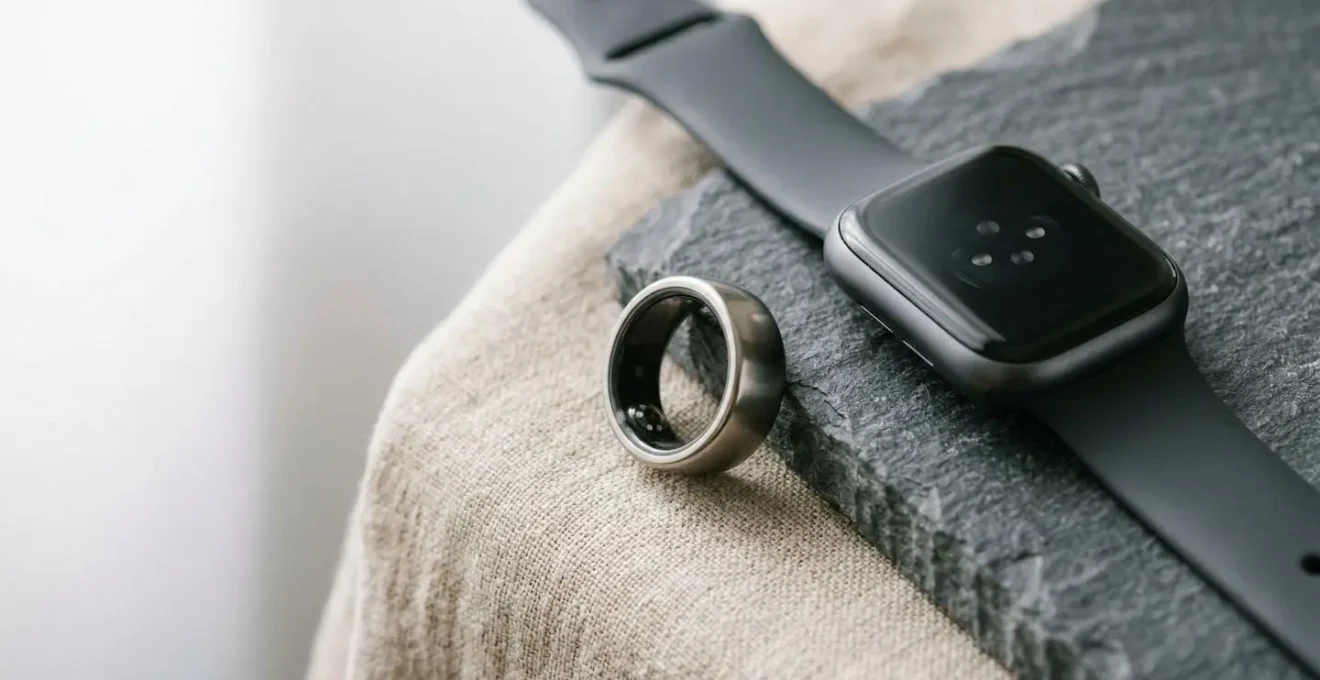
Smart rings are consistently more accurate for sleep tracking, not due to brand magic, but because of fundamental physics and a focused design.
- A ring’s placement on the finger provides a stronger, more stable biological signal (blood flow) than a watch on the highly mobile wrist.
- Rings prioritize long-term data collection over on-device features, leading to better battery life and fewer gaps in overnight tracking.
Recommendation: For gold-standard personal sleep data and trend analysis, choose a smart ring. For a versatile all-day device where sleep tracking is a ‘good enough’ feature, a smartwatch is a reasonable compromise.
As a biohacker and product tester, I live by one rule: data over dogma. So when my friends ask me, “Should I get an Oura Ring or an Apple Watch for sleep?”, my answer isn’t about aesthetics or brand loyalty. It’s about physics. We’ve all been there: waking up after what felt like a great night’s sleep, only to be told by our wrist-worn gadget that we barely recovered. This creates a frustrating disconnect. Most articles will tell you rings are more comfortable, and watches have more features. These are obvious, surface-level observations.
The real conversation is deeper. It’s not about the device itself, but about the quality of the raw data it can capture—its signal fidelity. The decision between a ring and a watch is a series of trade-offs between form factor physics, power consumption, algorithmic bias, and the business models that govern access to your own health data. The question isn’t just “which is more accurate?”, but “which is compromising less to give me a clearer picture of my health?”
This article moves beyond the marketing claims. We will dissect why sensors fail, how placement dictates accuracy, and what the hidden costs of data collection are. By understanding the underlying principles—from power architecture to the algorithmic interpretation of your movements—you’ll be able to make a truly informed decision based on data, not just hype. This isn’t another product review; it’s a strategic guide to choosing your health-tracking tool wisely.
To provide a clear and structured answer, this analysis is broken down into key areas that directly impact the accuracy and utility of these devices. The following sections will guide you through the technical, practical, and even financial trade-offs you’re making when choosing between a ring and a watch.
Summary: Smart Ring vs. Watch for Sleep Accuracy
- Why Optical Heart Rate Sensors Fail During High-Intensity Workouts?
- How to Wear Your Device Correctly to Avoid Data Gaps?
- The Health Data Risk: Who Owns Your Heart Rate History?
- Daily Charge vs Weekly Charge: Which Compromises Features Less?
- When to Buy: Is the Next Gen Sensor Upgrade Worth Waiting For?
- Why Beat Saber Burns as Many Calories as Tennis?
- How to Extend Tablet Battery Life for 12-Hour Field Shifts?
- When Should You Avoid Telemedicine and See a Doctor in Person?
Why Optical Heart Rate Sensors Fail During High-Intensity Workouts?
The very reason an optical heart rate (HR) sensor on a watch struggles during a kettlebell swing is the same reason it struggles to get pristine data while you sleep: motion artifacts. These sensors, known as photoplethysmography (PPG) sensors, work by shining light into your tissue and measuring how much light bounces back. Changes in blood volume with each heartbeat alter the light reflection. However, any movement—from a wrist flexion to simply shifting in your sleep—can disrupt this delicate measurement, creating “noise” that pollutes the “signal”.
This isn’t just about high-intensity workouts. As the Sleep Advances Journal Research Team notes, “PPG readings can be affected by motion artifacts, skin pigmentation, or tissue thickness. In addition, they could be susceptible to environmental factors such as ambient light and temperature.” Even when you think you’re still, the wrist is a highly mobile joint with less consistent blood flow compared to the finger. The challenge for these devices is to distinguish a genuine change in heart rate from the noise of a slight hand movement. This fundamental physical limitation is the first clue in understanding the accuracy gap between rings and watches.
How to Wear Your Device Correctly to Avoid Data Gaps?
If motion is the enemy of clean data, then the solution is stability. This is where form factor physics gives smart rings a decisive, undeniable edge for sleep tracking. The finger, particularly the index finger, has a rich supply of blood vessels (the radial and ulnar arteries) close to the surface and is far more stable during sleep than the wrist. The snug, 360-degree contact of a ring minimizes movement and light leakage, maximizing signal fidelity. In contrast, a watch band can loosen, rotate, or shift, creating gaps in data.
The data proves this point unequivocally. A peer-reviewed validation study found that smart rings showed a remarkable r=0.86 correlation for total sleep time against medical-grade actigraphy. Smartwatches, in the same study, managed only r=0.59. This isn’t a small difference; it’s the gap between a reliable tool and a rough estimate. Getting this right starts with fit. A device that’s too loose will generate junk data, while one that’s too tight can restrict blood flow, also corrupting the reading. Following a proper fitting protocol is not just a suggestion; it’s a prerequisite for obtaining data you can actually trust.
Action Plan: Achieving Optimal Sensor Fit
- Ring Placement: Wear the ring on your index finger whenever possible. It offers the strongest and clearest pulse signal for PPG sensors.
- Snug Fit Check: Ensure a snug but comfortable fit. The ring should not rotate freely on your finger, but it must not be so tight that it restricts circulation or leaves a deep indent.
- Sizing for Swelling: Account for natural finger swelling, which often occurs overnight or after exercise. Test a sizing kit at different times of the day before committing to a purchase.
- The Watch ‘Two-Finger’ Rule: For smartwatches, you should be able to slide two fingers side-by-side under the band when it’s secured. This ensures it’s tight enough for sensor contact without being constrictive.
- Watch Positioning: Always position the watch 1-2 cm (about one inch) above the prominent wrist bone. This prevents the device from compressing the ulnar artery, a common cause of corrupted heart rate data.
The Health Data Risk: Who Owns Your Heart Rate History?
Once you’ve collected that data, the next critical question is: who owns it, who protects it, and who can profit from it? This is a major point of divergence. Many users assume their health data is protected by regulations like HIPAA in the United States. They are mistaken. For the vast majority of consumer wearables, your data exists in a regulatory gray area. As long as the data isn’t being shared with a healthcare provider in a formal doctor-patient context, it’s often treated like any other consumer data.
This lack of oversight has profound implications for your privacy. The data you generate—your sleep patterns, resting heart rate, and activity levels—is a valuable commodity. This has given rise to the “data-for-a-fee” model. For instance, NBC Select’s analysis reveals that a $5.99/month subscription is required to access the full suite of health insights from an Oura Ring. You are, in effect, paying a monthly fee to analyze the data you yourself have generated on a device you’ve already purchased. This business model incentivizes companies to keep your detailed data locked within their ecosystem.
Commercial wearable health devices do not fall under FDA oversight, and data not paired with a doctor-patient relationship do not fall under HIPAA privacy protection; thus, much of the gathered health-related metrics are left without regulation and open to be sold to data brokers.
– Journal of Cybersecurity in Health Information Management, Wearable Health Monitoring Devices and Privacy Regulations in the U.S.
Daily Charge vs Weekly Charge: Which Compromises Features Less?
The frequency of charging isn’t just an inconvenience; it’s a direct indicator of a device’s core design philosophy and a major factor in data consistency. This is the power-sensing trade-off in action. Smartwatches, with their bright screens, GPS radios, and on-device app processing, are power-hungry. This necessitates daily charging. Smart rings, lacking these features, are hyper-efficient data collectors designed for longevity. The result is that many smart rings last up to 8 days per charge while many smartwatches require daily charging.
This difference has a cascading effect on sleep tracking accuracy. A daily charging routine inevitably creates gaps. Do you charge it overnight and lose your sleep data? Or charge it before bed and risk the battery dying before you wake? This “charging friction” is a primary reason for inconsistent data and, ultimately, for users abandoning the device altogether.
Case Study: User Abandonment Due to Charging Friction
A study on wearable usage patterns found that over 30% of smartwatch users stopped wearing their device within a year. The leading causes were not a lack of features, but comfort and the inconvenience of the charging cycle. Researchers specifically highlighted a common behavior: users taking off bulky smartwatches before bed for comfort. This action systematically creates massive gaps in sleep data collection, which directly undermines the device’s primary value proposition for anyone serious about health monitoring.
A smart ring’s “charge it once a week” schedule almost entirely eliminates this problem, ensuring you capture a complete, uninterrupted record of your sleep, night after night. This consistency is far more valuable for trend analysis than the fragmented data often produced by a daily-charge device.
When to Buy: Is the Next Gen Sensor Upgrade Worth Waiting For?
In the world of tech, there’s always a new, better model on the horizon. For health wearables, this usually means a “next-gen sensor” promising greater accuracy. But are these upgrades revolutionary or merely evolutionary? The data suggests the latter. Companies are making real, measurable gains, but they are incremental. For example, a Brigham and Women’s Hospital study found the Oura Ring Gen 4 demonstrated 5% higher accuracy than the Apple Watch in four-stage sleep classification. This is a meaningful improvement, but not a complete game-changer.
The bigger improvements are often in the algorithms that interpret the sensor data. As more data is collected, these algorithms get better at distinguishing sleep stages and filtering out noise. However, it’s crucial to maintain perspective on what these devices can and cannot do, regardless of the generation. They are tools for trend analysis, not clinical diagnosis.
The algorithms used by major brands have become highly accurate for determining when someone is asleep. The devices are also somewhat helpful for estimating sleep stages, though an in-lab study would be more precise.
– Dr. Daniel Forger, University of Michigan sleep wearables research, quoted in Euronews Health
Waiting for the “perfect” sensor is a fool’s errand. The current generation of smart rings already offers excellent signal fidelity. A far better strategy is to buy a quality device now and start collecting a baseline of your personal data. A year’s worth of “good” data from today’s device is infinitely more valuable than waiting for a “perfect” device that’s always six months away.
Why Beat Saber Burns as Many Calories as Tennis?
This question seems out of place, but it perfectly illustrates the concept of algorithmic bias. The reason a VR game can register as a high-calorie activity is that the device’s algorithm is not measuring calories directly. It’s estimating them based on a formula that uses heart rate and motion data. Rapid, intense arm movements and an elevated heart rate, whether from swinging a racket or a virtual lightsaber, can look similar to the algorithm. This same principle of algorithmic interpretation is at the heart of sleep tracking inaccuracies.
Your device doesn’t “know” you’re in REM sleep. It infers it by analyzing patterns in your heart rate variability (HRV), respiratory rate, and micro-movements, and then comparing these patterns to a pre-programmed model of what REM sleep *should* look like. As a result, the same algorithmic biases that misinterpret exercise can also misclassify ‘Restless Wakefulness’ as ‘Light Sleep’. The more complex the model, the more room for error. This is why meta-analysis research demonstrates that accuracy for a simple three-stage sleep model (wake/light/deep) can be around 78%, but drops significantly when trying to distinguish five stages (adding REM and awake).
The takeaway is that the “Sleep Score” you see in the morning is not a raw measurement. It is a heavily processed, proprietary interpretation. Understanding this “data-to-insight gap” is crucial. You must treat these scores as directional guidance, not as gospel truth.
How to Extend Tablet Battery Life for 12-Hour Field Shifts?
Again, let’s use an analogy to understand a core principle. A field tablet designed for a 12-hour shift prioritizes battery life and data connection over on-device processing power. This is the exact architectural philosophy of a smart ring. A smart ring is not a tiny computer on your finger; it is a highly specialized, low-power data collection terminal. Its primary job is to sense, store, and then offload that data to your phone for the heavy lifting of processing and analysis. This is the key to its multi-day battery life.
A smartwatch, by contrast, operates more like a laptop. It has a powerful processor, a bright display, and runs apps directly on the device. It’s designed for real-time interaction and feedback. This on-device processing is incredibly power-intensive and is the main reason a watch requires daily charging. Neither approach is inherently “better,” but they are designed for fundamentally different purposes.
Architectural Showdown: On-Device vs. Cloud Processing
The power architecture difference between smart rings and watches is stark. Rings like Oura are engineered to function primarily as passive data collectors. They offload almost all intensive processing to the connected smartphone and cloud infrastructure. This preserves their minuscule battery for the one thing that matters: pure, continuous sensing over 7+ days. In contrast, watches perform significant on-device processing for real-time notifications, app interactions, and immediate feedback. This provides instant insights without needing a phone but comes at the non-negotiable cost of battery life, mandating a daily charging cycle that can disrupt continuous overnight data collection.
For the specific task of sleep tracking, the ring’s architecture is objectively superior because it maximizes the single most important variable: uninterrupted, long-term data capture.
Key Takeaways
- Smart rings are more accurate for sleep tracking primarily due to superior signal fidelity from the stable, vascular-rich environment of the finger.
- Smartwatches compromise sleep tracking precision for all-day features like screens and on-device apps, a trade-off reflected in their daily charging needs.
- Your wearable health data is generally not protected by HIPAA, and access to your own detailed insights is increasingly locked behind monthly subscriptions.
When Should You Avoid Telemedicine and See a Doctor in Person?
This final question brings our entire discussion to its logical conclusion. When is the data from your consumer wearable not enough? The simple answer: whenever a medical diagnosis is required. The data from your ring or watch is a powerful tool for wellness optimization, for noticing trends, and for building healthier habits. It is not, and was never intended to be, a diagnostic medical device. The risk of treating it as such is a modern condition that researchers have dubbed ‘orthosomnia’—an unhealthy obsession with achieving perfect sleep scores that can, paradoxically, increase anxiety and worsen sleep.
I remember I would go to bed thinking about the score I was going to get in the morning. I became obsessed enough with my nightly sleep scores that it began to cause me anxiety—a modern condition that researchers have dubbed ‘orthosomnia.’
– Mai Barreneche, Oura Ring user testimonial, Euronews Health investigation
Furthermore, the accuracy of these devices can plummet in the very populations that might need them most. While they are good at detecting sleep in healthy individuals, a Nature Scientific Reports study in clinical settings found their specificity (ability to correctly identify wakefulness) ranged from a poor 0.18 to 0.54 in populations with sleep disorders. In short, they are good at confirming you’re asleep when you are, but terrible at identifying when you’re awake if you have a condition like insomnia.
Use your wearable data to open a conversation with your doctor, not to replace one. Present them with long-term trends in your resting heart rate or HRV, not with a single “Readiness Score.” The data is context; the doctor provides the diagnosis.
Now that you understand the deep trade-offs between form factors, data privacy, and algorithmic interpretation, the next step is to perform an honest audit of your own needs. Are you a data-driven individual seeking to optimize every aspect of your physiology, or are you looking for a convenient, all-in-one device with good-enough insights? Your answer will determine whether the ring or the watch is the right tool for you.