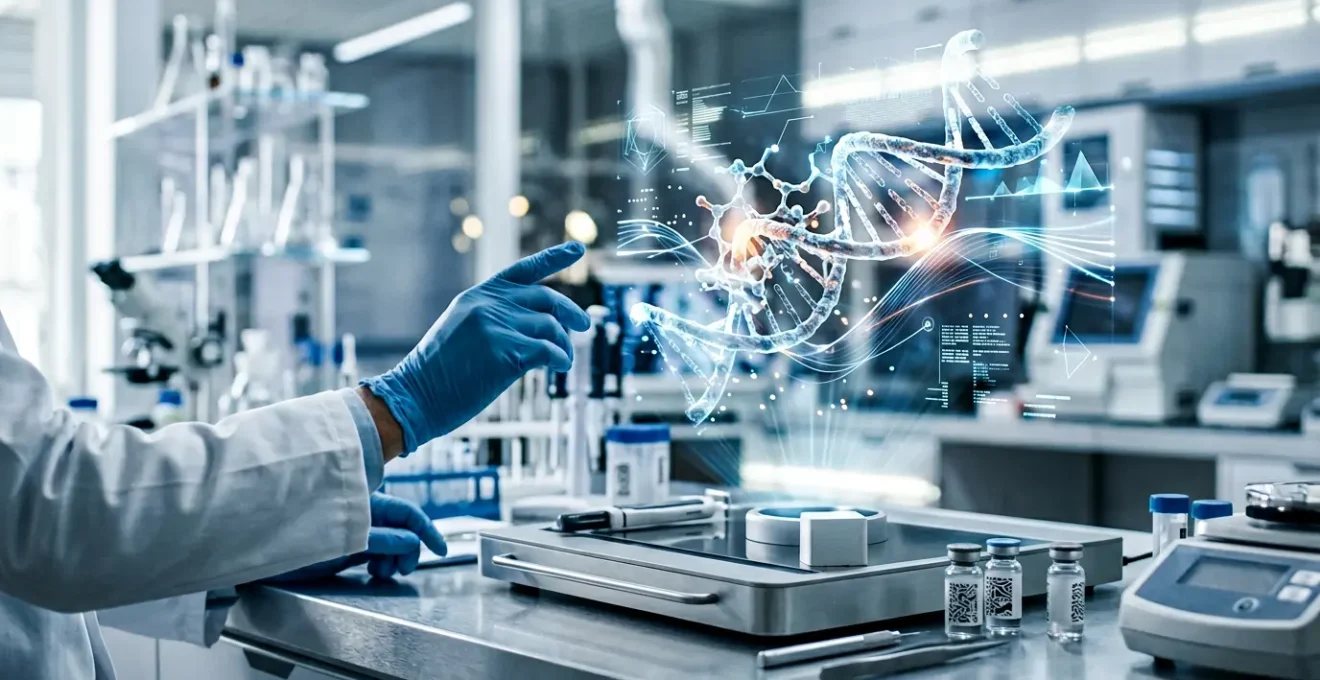
Despite the ethical imperative and technological hype, computational models cannot yet fully replace animal testing due to fundamental scientific hurdles in predicting complex biological interactions.
- Current models, including advanced AI like AlphaFold, excel at isolated tasks but struggle to simulate the systemic effects an ingredient has on a whole organism.
- Predictive methods like QSAR are prone to significant “false positive” rates, incorrectly flagging safe ingredients as toxic, which poses a major roadblock to their reliability.
Recommendation: Focus on a hybrid approach, combining the speed of in silico screening with the biological relevance of in vitro methods (like organ-on-a-chip) and microdosing, while advocating for stricter validation standards for all non-animal models.
The call to end animal testing in the cosmetics industry is louder and more urgent than ever. Driven by ethical consumerism and a genuine desire for cruelty-free products, the industry has turned to a seemingly perfect solution: computer models. The promise is alluring—fast, cheap, and ethical simulations, often referred to as in silico testing, that can predict the toxicity of an ingredient without harming a single animal. Technologies like “organ-on-a-chip” and AI-driven protein prediction are frequently heralded as the final nails in the coffin for animal-based research.
However, this optimistic narrative often overlooks a more complex scientific reality. The transition is not a simple switch from a lab bench to a supercomputer. While the ethical argument is clear, the scientific validity is not. The critical question is not whether we want to replace animal testing, but whether current computational models are truly capable of shouldering the immense responsibility of ensuring human safety. The core challenge lies beyond just predicting a single molecular interaction; it involves simulating the intricate, interconnected symphony of a living biological system.
This article moves beyond the headlines to dissect the true capabilities and, more importantly, the current limitations of computational alternatives. We will not simply list pros and cons. Instead, we will delve into the specific computational hurdles—from predictive accuracy flaws in modeling to the immense challenge of simulating systemic biological responses—that stand between the promise and the reality. By understanding these scientific bottlenecks, we can foster a more realistic and effective roadmap toward a future that is both ethical and safe.
To navigate this complex topic, we will explore the key technologies and challenges shaping the future of cosmetic testing. This structured analysis will provide a clear view of where we stand and the scientific milestones we must still achieve.
Summary: The Scientific Hurdles of Replacing Animal Testing
- Why Virtual Clinical Trials Are Cheaper but Riskier?
- How to Use AlphaFold to Predict Protein Structures for Free?
- In Vitro vs In Silico: Which Method Predicts Toxicity Better?
- The Modeling Mistake That Leads to False Positive Drug Candidates
- When Can We Expect a Fully Simulated Human Organ for Testing?
- Classical Supercomputers vs Quantum: Which Wins for Drug Discovery?
- How to Check if a Tech Brand Is Truly Sustainable?
- Smart Pills: Are We Ready to Swallow Computers for Diagnosis?
Why Virtual Clinical Trials Are Cheaper but Riskier?
The primary driver behind the push for virtual, or in silico, trials is economic. Traditional clinical trials are notoriously expensive and time-consuming. By simulating the effects of a cosmetic ingredient on a computer, companies can screen thousands of compounds for a fraction of the cost and time. The market for these technologies is booming, with projections showing a growth from $10,720 million in 2024 to $15,658.22 million by 2032. This financial incentive is a powerful catalyst for innovation.
However, this cost-effectiveness comes with a significant risk: a lack of biological complexity. A computer model is only as good as the data it’s trained on and the biological pathways it’s programmed to consider. Living organisms are a web of interconnected systems. An ingredient might be safe for skin cells in an isolated simulation (a local effect), but it could be metabolized by the liver into a toxic substance that affects the kidneys (a systemic effect). Current models often fail to capture this systemic complexity, creating a potential gap in safety assessment.
Clinical trials are highly complex and stringently regularized due to the high-cost investment and involvement of a huge patient population and associated data.
– ResearchAndMarkets Industry Report, Virtual Clinical Trials Market – Focused Insights 2024-2029
The risk, therefore, is not just financial but also biological. A false sense of security derived from an oversimplified model could lead to unforeseen adverse reactions in the real world. The challenge is to build models that don’t just test ingredients in isolation but can begin to predict the cascade of reactions they might trigger throughout the human body. This gap between isolated prediction and systemic reality is the fundamental risk of relying solely on cheaper, virtual methods today.
How to Use AlphaFold to Predict Protein Structures for Free?
AlphaFold, a revolutionary AI system developed by Google’s DeepMind, has fundamentally changed structural biology. It can predict the three-dimensional structure of a protein from its amino acid sequence with astonishing accuracy. For scientists, this is a game-changer. The tool is freely accessible through the AlphaFold Database, which has made over 200 million protein structure predictions available to the global scientific community. This allows researchers to visualize the molecular machinery they are working with, a critical step in understanding its function.
This paragraph introduces the complex concept of protein folding. To better understand its visual representation, the illustration below depicts the intricate three-dimensional structure predicted by AI.
As the image shows, knowing the shape of a protein is essential. In cosmetics, a key toxicity concern is whether an ingredient will bind to a specific protein and disrupt its normal function. Using AlphaFold, a scientist can predict the structure of a target skin protein and then use docking software to simulate whether a new cosmetic ingredient is likely to “fit” into a critical part of that protein. This provides a powerful, hypothesis-generating tool to flag potential interactions early on.
However, there’s a crucial limitation. AlphaFold provides a static picture of a protein’s most likely shape. In reality, proteins are dynamic; they move, flex, and change shape. Furthermore, predicting a structure is not the same as predicting function or toxicity. A compound might bind to a protein without causing any harm, or it might not bind at all but cause toxicity through other mechanisms, such as oxidative stress. Therefore, while AlphaFold is an unparalleled tool for generating structural hypotheses, it is not a crystal ball for predicting overall biological outcomes. It’s one piece of a much larger predictive validity puzzle.
In Vitro vs In Silico: Which Method Predicts Toxicity Better?
The debate over replacing animal testing often centers on two main alternatives: in vitro and in silico. In silico methods, as we’ve discussed, rely on computer simulations. In vitro (“in glass”) methods use living human cells or tissues grown in a lab environment, such as petri dishes or more advanced “organ-on-a-chip” devices. Each approach has distinct advantages and disadvantages when it comes to predicting toxicity.
The most significant advantage of in silico modeling is speed. As research published in Digital Discovery demonstrates, a computer can screen a potential toxin in seconds, whereas a standard in vitro assay might take several days. This allows for massive, high-throughput screening of thousands of molecules at the initial stages of development. However, this speed comes at the cost of biological abstraction. The model makes assumptions and simplifies complex cellular processes.
In vitro methods, on the other hand, offer higher biological fidelity. Testing an ingredient on actual human skin cells, for example, provides a more direct measure of its potential for irritation or cellular damage. It moves from theoretical prediction to tangible observation. The downside is that even advanced in vitro systems cannot fully replicate the systemic interactions of a whole organism. Neither method, on its own, is a perfect predictor of human toxicity. The current scientific consensus is that they are most powerful when used together. In silico models can rapidly filter a large library of compounds down to a few promising or concerning candidates, which can then be validated more rigorously using targeted in vitro assays. This tiered approach leverages the speed of one and the biological relevance of the other, creating a more robust, non-animal testing strategy.
The Modeling Mistake That Leads to False Positive Drug Candidates
One of the most significant scientific hurdles for in silico toxicology is the problem of “false positives.” A false positive occurs when a computational model incorrectly flags a safe compound as toxic. This is a common issue in models based on Quantitative Structure-Activity Relationships (QSAR), which try to predict a molecule’s toxicity based on its chemical structure. The model learns from a database of known toxins and non-toxins and then makes predictions about new, unseen molecules.
This paragraph explains the challenge of distinguishing true predictions from false ones. The following illustration provides a conceptual view of this data sorting and reclassification process in computational modeling.
The mistake lies in the model’s “applicability domain.” A QSAR model is only reliable for chemicals similar to those it was trained on. If a new cosmetic ingredient has a novel chemical structure, the model may be operating outside its area of expertise, leading to an erroneous prediction. This is not a minor issue; research published in Scientific Reports indicates that even high-performing QSAR models can have a 20% false positive rate. This means that one in five safe and potentially innovative ingredients could be wrongly discarded, stifling development and leading to economic losses.
This high rate of false positives undermines regulatory trust in these models. For a method to replace animal testing, it needs to be not only good at identifying toxins (high sensitivity) but also excellent at correctly identifying non-toxins (high specificity). A model that cries wolf too often is ultimately unreliable. The ongoing challenge for computational biologists is to build more robust models and, crucially, to clearly define their data domain applicability, so that users know when the model’s prediction can be trusted and when it is merely a guess.
When Can We Expect a Fully Simulated Human Organ for Testing?
The concept of a fully simulated human organ represents the next frontier in in silico and in vitro testing. The most promising technology in this area is “organ-on-a-chip” (OOC). These are microfluidic devices, often the size of a USB stick, lined with living human cells from a specific organ (e.g., liver, skin, lung). They are designed to mimic the key functions and physiological responses of that organ. This allows scientists to test the effects of ingredients on a functional, human-derived biological system without animal testing.
The progress in this field is tangible and exciting. By connecting multiple OOCs, researchers can even begin to simulate systemic interactions, for example, by observing how a compound absorbed by a “skin chip” is then metabolized by a “liver chip.” This moves beyond isolated cell cultures and gets one step closer to modeling a multi-organ organism.
Case Study: Organ-on-a-Chip for Drug and Cosmetic Ingredient Testing
The potential of this technology is highlighted in recent studies. According to an article from Johns Hopkins University, researchers successfully used a heart-liver-bone-skin chip to test the cancer drug doxorubicin, and the results matched those from human clinical trials. In another significant study, cosmetic ingredients were tested on a skin-liver-thyroid chip. The results from the chip were able to predict safe dosages that were within a fraction of the currently accepted safety standards, demonstrating its high predictive power and potential to refine safety assessments.
So, when can we expect a fully simulated human for testing? The reality is, we are still decades away. While OOCs are a monumental leap forward, they still only represent a fraction of the body’s complexity. Simulating the entire human body—with its trillions of cells, intricate hormonal feedback loops, and complex immune system—is a computational and biological challenge of staggering proportions. For the foreseeable future, OOCs will serve as powerful tools to reduce and refine animal testing by providing more relevant human data, but they are not yet a complete replacement. They represent a critical bridge, not the final destination.
Classical Supercomputers vs Quantum: Which Wins for Drug Discovery?
When discussing the future of computational modeling, the conversation inevitably turns to quantum computing. It’s often portrayed as a magic bullet that will solve all the limitations of current “classical” supercomputers. However, their roles in drug and cosmetic discovery are fundamentally different, and quantum computing is not simply a “faster” version of what we have now.
Classical supercomputers operate on bits (0s and 1s) and excel at tasks based on statistics and data pattern recognition. In toxicology, they are used for QSAR models, where they analyze vast databases to find correlations between a molecule’s structure and its known toxicity. They answer the question: “Based on what we’ve seen before, is this new molecule *likely* to be toxic?” It is a powerful but probabilistic approach, prone to the errors we discussed earlier.
Quantum computers, on the other hand, operate on qubits, which can exist in multiple states at once. This allows them to simulate molecular behavior at the fundamental level of quantum mechanics. Instead of relying on statistical patterns, a quantum computer could, in theory, model the precise electronic interactions between an ingredient and a specific protein in your body. It would move from probabilistic correlation to deterministic simulation.
Classical computing can tell you what ingredients are likely to be toxic based on statistical patterns. Quantum computing will be able to tell you why at a fundamental quantum-mechanical level, simulating the precise electron interactions between an ingredient and a protein.
– Journal of Chemical Information and Modeling Research, AlphaFold Meets De Novo Drug Design: Leveraging Structural Protein Information
So, which wins? For now, and for the next decade, classical supercomputers are the undisputed workhorses of drug discovery and toxicology screening. Quantum computing is still in its infancy, facing immense hardware and algorithmic challenges. It holds the ultimate promise of answering “why” a compound is toxic, not just “if,” but this is a long-term vision. The near-future “win” belongs to the synergistic use of increasingly powerful classical computers and more refined in silico and in vitro models.
Key Takeaways
- The replacement of animal testing is not a single technological switch but a complex scientific transition requiring multiple, validated methods.
- Computational models (in silico) are powerful for high-speed screening but are limited by their inability to fully capture systemic biological interactions and are prone to predictive errors like false positives.
- A hybrid approach, combining in silico screening with in vitro validation (like organ-on-a-chip), offers the most robust and scientifically sound path toward reducing and eventually replacing animal testing.
How to Check if a Tech Brand Is Truly Sustainable?
The term “sustainable” in technology, especially concerning alternatives to animal testing, extends beyond the single issue of animal welfare. A truly sustainable approach must also consider the method’s scientific validity, efficiency, and even its environmental footprint. For ethical consumers and regulators, verifying a brand’s claims of using “sustainable” or “cruelty-free” technology requires looking beyond the marketing label.
This ethical consideration involves balancing rapid technological advancement with long-term environmental and scientific responsibility, a contemplation captured in the following image.
Firstly, transparency is key. A brand committed to sustainable science should be open about its testing methods. Does it rely solely on simplistic QSAR models, or does it employ a tiered strategy that includes more advanced in vitro tests like those on 3D tissue models or organ-on-a-chip? The presence of a multi-faceted approach is a strong indicator of scientific rigor. As Humane World for Animals notes, ” Nearly 50 non-animal tests are already available, with many more in development,” which provides a rich toolkit for responsible companies.
Secondly, consider the energy cost. Large-scale computational simulations and AI model training consume vast amounts of electricity. A truly sustainable tech approach involves optimizing algorithms and using energy-efficient data centers. While this is a more technical aspect, brands committed to environmental sustainability may report on the energy efficiency of their computational infrastructure. The ultimate goal is a methodology that is not only ethically and scientifically sound but also environmentally responsible.
Action Plan: How to Assess a Method’s True Sustainability
- Method Disclosure: Check if the brand clearly specifies its non-animal testing methods (e.g., QSAR, organ-on-a-chip, 3D tissue models). Vague claims are a red flag.
- Data Transparency: Look for publications, white papers, or data shared by the brand that validate the accuracy and limitations of their chosen methods.
- Tiered Approach Evidence: Verify if they use a combination of methods (e.g., in silico screening followed by in vitro confirmation) rather than relying on a single, potentially flawed model.
- Regulatory Acceptance: Investigate if their alternative methods are recognized or validated by regulatory bodies like the OECD (Organisation for Economic Co-operation and Development) or ECHA (European Chemicals Agency).
- Environmental Reporting: For computational-heavy methods, check if the company reports on the energy efficiency of its data centers or other efforts to mitigate its computational carbon footprint.
Smart Pills: Are We Ready to Swallow Computers for Diagnosis?
While much of the focus is on replacing external tests, another revolutionary approach aims to gather data from inside the human body itself, minimizing the need for large-scale trials later on. “Smart pills” or ingestible sensors are tiny electronic devices designed to be swallowed. They can monitor physiological conditions, collect data from the gastrointestinal tract, and even release medication at specific locations. This technology offers a window into the human body’s internal environment that is impossible to replicate perfectly on a computer or in a petri dish.
In the context of toxicology, a related and less invasive concept is microdosing. This method is becoming a cornerstone of modern, ethical drug development and has direct relevance for cosmetic ingredient safety. It involves administering an extremely small, sub-therapeutic dose of a compound to human volunteers—a dose too low to produce any whole-body effect but large enough to be measured in the bloodstream.
A method called ‘microdosing’ can provide vital information on the safety of an experimental drug and how it is metabolized in humans prior to large-scale human trials.
– PETA Research Documentation, In Vitro Methods and More Animal Testing Alternatives
By analyzing how the human body absorbs, distributes, metabolizes, and excretes this microdose, scientists can gain invaluable data on a compound’s real-world behavior. This information can then be used to build far more accurate and human-relevant computational models. Instead of relying on animal data to inform the models, we can use human data from the very beginning. This approach doesn’t replace in silico models; it makes them smarter and more reliable. It represents a powerful synthesis: using minimal, safe human testing to supercharge the predictive power of our computational tools, bringing us one step closer to a truly animal-free future.
The journey to replacing animal testing is not about finding a single magic bullet, but about intelligently combining a suite of advanced technologies. From the predictive power of AI to the biological relevance of organ-on-a-chip and the real-world data from microdosing, the path forward is a hybrid one. It requires scientific rigor, ethical commitment, and a realistic understanding of both the immense potential and the current limitations of our technology.
To make informed decisions in this evolving landscape, it is essential to critically evaluate the claims of any single technology and advocate for a multi-faceted, validated approach to safety testing that prioritizes both human health and animal welfare.