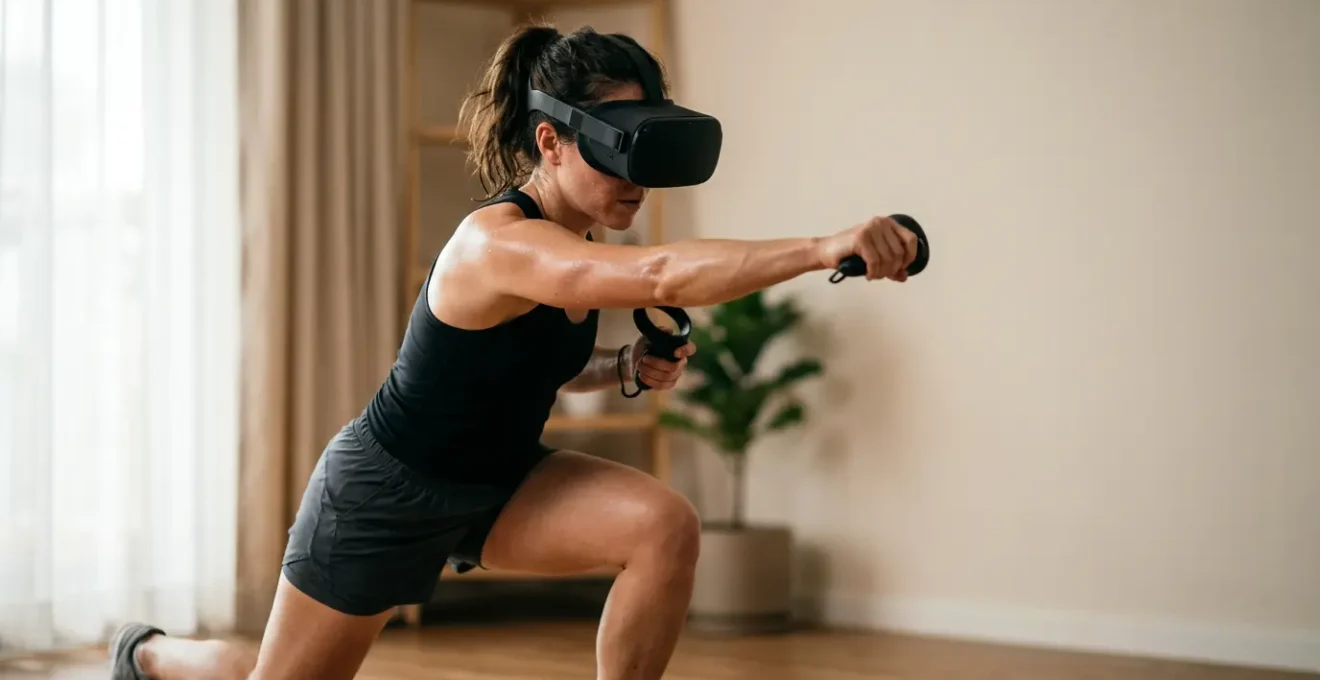
VR fitness can absolutely replace a traditional gym membership for cardio, but only if you shift your mindset from ‘playing a game’ to ‘executing a structured training program’.
- The caloric burn of top VR games is scientifically equivalent to intense sports like tennis, but this depends on skill and intentional movement, not just participation.
- Effective VR training requires a conscious approach to programming, injury prevention, and using accurate biometric data, just like any serious athletic endeavor.
Recommendation: Instead of asking if VR can replace the gym, ask how you can apply gym principles to VR. Use it as a powerful tool within a structured weekly plan focused on progressive overload and recovery.
The thought of another monotonous hour on the treadmill or elliptical is enough to make anyone’s motivation crumble. It’s no wonder that the promise of virtual reality (VR) fitness—swapping the gym’s stale air for epic landscapes and heart-pounding beats—feels like a revolution. You’ve heard the claims: it’s more fun, it’s convenient, and you can burn a surprising number of calories. Many articles will simply list the “top 5 games” and leave it at that, treating it as a novel distraction.
But for those of us serious about our physical well-being, the core question remains. Can slashing through virtual blocks or ducking under digital walls truly provide the physiological stimulus needed for real, lasting fitness results? Can it replace the structured environment of a gym? The common wisdom suggests it’s a fun supplement, but lacks the seriousness of traditional training. This perspective, however, misses the bigger picture entirely.
The secret isn’t in the games themselves, but in how you approach them. The true potential of VR fitness is unlocked when you stop viewing it as a game and start treating it as a high-tech training tool. What if the key to replacing your gym membership wasn’t about finding the most entertaining game, but about applying the fundamental principles of exercise physiology, biomechanics, and data-driven programming to your virtual workouts? This guide will break down not just *if* you can get fit in VR, but precisely *how* to do it safely and effectively, transforming your headset from a toy into a personal performance lab.
Summary: From Gamified Exercise to True Virtual Training
- Why Beat Saber Burns as Many Calories as Tennis?
- How to Protect Your Headset from Moisture Damage During Workouts?
- The “Tennis Elbow” Risk in VR Boxing and How to Avoid It
- How to Structure a VR Cardio Session for Maximum Fat Loss?
- Supernatural vs FitXR: Which Subscription Offers Better Coaching?
- Why Optical Heart Rate Sensors Fail During High-Intensity Workouts?
- The Isolation Risk of Spending Too Much Time in Social VR
- Are Smart Rings More Accurate Than Watches for Sleep Tracking?
Why Beat Saber Burns as Many Calories as Tennis?
The idea that a rhythm game could rival a physically demanding sport like tennis seems improbable, yet the data supports it. The key lies in a physiological metric called the Metabolic Equivalent of Task (MET), which measures energy expenditure. Studies from the Virtual Reality Institute of Health and Exercise show that playing Beat Saber registers an average of 6.24 METs, with a range of 6-8 METs. This is a level of intensity directly equivalent to a friendly game of tennis.
But how is this possible? Unlike traditional exercise where efficiency is the goal, VR fitness can create a unique “efficiency paradox.” An analysis of expert Beat Saber players revealed something counter-intuitive: as skill increases, so does energy expenditure. While learning most motor skills involves finding the most efficient, energy-saving movements (like tiny wrist flicks), the design of expert-level Beat Saber maps forces the opposite. The sheer speed and density of blocks demand large, sustained, and explosive full-body movements—deep squats, lunges, and powerful arm swings—to succeed.
Case Study: The Expert Player’s Calorie Burn
A study documented by Road to VR showed a fascinating trend in Beat Saber. Moderate players burned a respectable amount of energy. However, expert players tackling the highest difficulties saw their caloric burn skyrocket to between 8.57 and 9.86 kcals per minute (for a 60kg person). This happens because advanced levels are designed to force inefficient, large-scale movements, effectively turning the player into a calorie-burning engine. This confirms that in VR, greater skill can directly lead to a more intense workout, not an easier one.
This demonstrates a core principle of effective VR fitness: intensity is a product of both the game’s demands and your commitment to meeting them with your entire body. Simply waving your wrists won’t cut it. To achieve a tennis-level workout, you must engage your legs, core, and shoulders, treating each block as a target for a full-body athletic movement. As the VR Health Institute’s research team noted, the potential for higher energy expenditure is directly tied to the user’s skill and willingness to move.
How to Protect Your Headset from Moisture Damage During Workouts?
If you’re using VR for a genuine workout, you’re going to sweat—a lot. This is a sign of a great session, but it’s also the number one enemy of your headset’s sensitive electronics and foam padding. Letting moisture accumulate can lead to foggy lenses, skin irritation, and permanent damage to your device. Treating your headset like a piece of high-performance athletic gear is non-negotiable. Proper sweat management is as crucial as proper form.
The first line of defense is creating a barrier between your skin and the headset. The stock foam interface that comes with most headsets is a sweat sponge, quickly becoming unhygienic and worn. The solution is a multi-layered approach focused on absorption, ventilation, and sanitation. Investing in a few key accessories can dramatically extend the life of your headset and make your workouts far more comfortable and hygienic for you and anyone else who might use it.
As you can see in the texture of specialized materials, the focus is on breathability and moisture-wicking properties. Your setup should include:
- Personal, Washable Face Pad: Every user should have their own removable facial interface. Silicone covers are easy to wipe down, while absorbent foam replacements can be washed.
- Absorbent Headbands: A simple athletic headband worn at the hairline is a game-changer. It intercepts the majority of forehead sweat before it can even reach the headset.
- Vented Interfaces: Companies like VR Cover offer custom facial interfaces with built-in vents. These promote airflow inside the headset, reducing humidity and preventing lens fog during intense sessions.
- Post-Workout Protocol: Immediately after your workout, wipe down the headset and controllers with a microfiber cloth. Never use alcohol-based wipes on the lenses. Remove the facial interface and let all components air dry completely before storing them.
Some commercial VR arcades even use medical-grade UV-C light boxes for sanitation. While not necessary for home use, it highlights the importance of a dedicated hygiene protocol. Protecting your investment ensures you can keep training consistently without technical interruptions.
The “Tennis Elbow” Risk in VR Boxing and How to Avoid It
VR boxing games are incredible for high-intensity cardio, but they come with a unique biomechanical risk. Many users report elbow and wrist pain, often self-diagnosing it as “tennis elbow.” However, the actual mechanism of injury is often different and more specific to the act of “punching air.” In real boxing, impact with a bag or opponent decelerates your arm. In VR, there’s no resistance. Your own muscles and joints must absorb 100% of the deceleration force at the end of every punch.
This repeated, uncontrolled extension can lead to a condition that’s common in real-world boxers. As one certified athletic therapist explains, this type of pain is often due to posterolateral elbow impingement. This is a trauma caused by repetitive hyperextension of the elbow during missed or uncontrolled punches. It’s not the swing that gets you; it’s the sudden stop at the very end of your range of motion. Furthermore, the community wisdom is clear on a related risk: adding wrist weights to increase intensity is extremely dangerous. It dramatically increases the deceleration forces on your joints and is widely advised against for fast-paced games.
The key to safe VR boxing is shifting your focus from raw power to impeccable form and control. You are not trying to hit a physical object; you are performing a controlled athletic movement. This requires a dedicated warm-up, a focus on proper biomechanics, and a structured cool-down, just like any other sport.
Action Plan: VR Boxing Injury Prevention
- Warm-up: Perform wrist rotations (10 reps each direction), light resistance band pull-aparts (15 reps), and forearm stretches (hold for 15 seconds) to prepare the joints and activate stabilizing muscles.
- Form Focus: Never fully lock out your elbow. Consciously stop every punch at about 95% of your full extension to protect the joint from hyperextension trauma.
- Session Duration: Limit initial sessions to 15-20 minutes. This allows your neuromuscular system to adapt to the unique stress of decelerating punches without external impact.
- Cool-down Stretches: After your session, perform wrist extensor stretches (hold for 30 seconds per side) and gentle forearm self-massage to prevent the onset of epicondylitis.
- Recovery Protocol: Allow at least 48 hours between intense VR boxing workouts. Your tendons need time to recover from this specific type of stress, which is different from traditional weightlifting or cardio.
By treating VR boxing with the respect of a martial art—focusing on control, conditioning, and recovery—you can reap its incredible cardiovascular benefits while sidestepping the common injuries that sideline enthusiastic new players.
How to Structure a VR Cardio Session for Maximum Fat Loss?
Jumping into a VR game and playing until you’re tired is exercise. But it’s not training. To achieve specific goals like maximum fat loss, you need to apply the same principles of structured programming that a personal trainer would use in a gym. This means strategically manipulating intensity, duration, and frequency throughout the week—a concept known as periodization. Your VR headset is the equipment; the weekly schedule is the program that delivers results.
A well-rounded VR fitness plan shouldn’t be monotonous. It should incorporate different types of stress to keep your body adapting and to prevent burnout or overuse injuries. This includes high-intensity interval training (HIIT) for maximum calorie burn and metabolic boost, as well as lower-intensity, steady-state (LISS) cardio for fat oxidation and recovery. The magic happens when you combine them intelligently.
Furthermore, the most advanced VR athletes use a technique called “off-headset integration.” This involves performing traditional bodyweight exercises in the short breaks between VR game levels or songs. This not only keeps your heart rate elevated but also engages major muscle groups that VR, with its focus on arm movement, can sometimes neglect. It’s about maximizing every minute of your workout time to boost the afterburn effect (EPOC), where your body continues to burn calories at an elevated rate long after you’ve taken the headset off.
Here’s what a sample weekly schedule applying these principles could look like, using a mix of popular apps:
- Monday – HIIT Day: A 25-30 minute session in a game like Les Mills BodyCombat. The combination of punches, squats, and knee strikes creates compound movements that drive your heart rate into zones 4-5 for a massive calorie burn, with some users reporting over 228 calories burned in a session.
- Wednesday – LISS Cardio Day: A 45-60 minute session in Beat Saber on “Hard” difficulty. The goal here isn’t to chase a high score but to move with large, exaggerated swings, keeping your heart rate in the steady-state zones 2-3, ideal for fat oxidation.
- Friday – Mixed Intensity Day: Start with a 20-minute Supernatural Flow workout for moderate intensity. Then, between each song or level, perform a set of bodyweight exercises (e.g., 10 squats, 10 push-ups) to integrate strength work.
- Sunday – Active Recovery Day: A light, 15-20 minute session in a VR stretching app or a low-intensity dance workout in FitXR. This promotes blood flow and recovery while reinforcing the habit of daily movement.
This structured approach ensures you’re getting a comprehensive workout that targets different energy systems, maximizes fat loss, and allows for proper recovery, turning your VR playtime into a legitimate and effective training regimen.
Supernatural vs FitXR: Which Subscription Offers Better Coaching?
Once you decide to get serious about VR fitness, you’ll likely face a choice between the two biggest subscription platforms: Supernatural and FitXR. While both offer a library of workouts, they have fundamentally different philosophies, especially when it comes to coaching. Choosing the right one depends on what motivates you: do you respond to a personal, encouraging voice, or to the thrill of competition and data-driven feedback?
Supernatural is built around its coaches. They appear as live-action videos during warm-ups and cool-downs and provide a constant stream of vocal encouragement and guidance throughout the workout. Their style is akin to a high-energy spin class instructor—motivational, celebratory, and focused on creating an emotional connection. The platform leverages licensed, popular music, and the coaches choreograph movements to the beat, creating a powerful, rhythm-based experience.
FitXR, on the other hand, takes a more gamified and diverse approach. While some classes have instructors, many rely on avatar-led sessions and a robust feedback system. The “coaching” comes from visual cues showing your accuracy, leaderboards driving competition, and a progression system that rewards consistency across its seven distinct studios (from Boxing to Zumba). It feels less like a class and more like a futuristic fitness arcade, with real-time multiplayer for up to 6 people adding a strong social, competitive element.
The following table breaks down the key differences in their coaching and platform philosophy, based on a detailed competitive analysis. This objective framework helps you decide which style of “virtual trainer” will best push you to achieve your goals.
| Evaluation Metric | Supernatural | FitXR |
|---|---|---|
| Coaching Presence | Live-action coaches appear during warm-up/cool-down with continuous voiceover guidance throughout workout | Minimal real trainer interaction; most classes use avatars (Dance/HIIT) with occasional encouragement callouts |
| Form Cues Quality | Proactive coaching with technique reminders; coaches describe upcoming movements before they happen | Reactive feedback system; visual indicators show accuracy but limited biomechanical instruction |
| Motivational Style | Encouraging cheerleader approach; coaches celebrate effort and provide emotional connection | Game-like challenge focus; leaderboards and score streaks drive competition over personal encouragement |
| Programming Logic | Curated progression with intensity levels (Low/Medium/High); workouts organized by duration and music genre but limited path structure | Seven distinct studios (Box, Dance, HIIT, Sculpt, Combat, Zumba, SLAM) with progression systems and rewards encouraging workout diversity |
| Music Integration | Licensed popular music drives choreography; movement patterns sometimes compromised for beat synchronization with familiar songs | Custom-produced tracks tailored to workout intensity; movements prioritize biomechanics over musical recognition |
| Subscription Cost (2026) | $18.99/month or $179.99/year (premium pricing for licensed music catalog) | $12.99/month or $108.99/year (more affordable with 7-day free trial) |
| Companion Ecosystem | Smartphone app with social following, workout comments, Apple Watch/fitness tracker integration, large Facebook community (20,000+ members) | Performance tracking with detailed metrics (calories, punch speed, accuracy), real-time multiplayer (up to 6 players), leaderboard competition |
Ultimately, there’s no single “better” coach. Do you need a cheerleader (Supernatural) or a rival (FitXR)? Your answer to that question will determine which platform is the superior training partner for you. Supernatural excels at extrinsic motivation through personality, while FitXR builds intrinsic motivation through gameplay loops and social competition.
Why Optical Heart Rate Sensors Fail During High-Intensity Workouts?
For anyone serious about training, data is everything. Heart rate tracking is the most direct way to measure workout intensity and ensure you’re in the right zone for your goals, whether it’s fat burning or peak performance. Most smartwatches use optical heart rate (OHR) sensors, which shine a light onto your skin to detect blood volume changes. While convenient, these sensors are notoriously unreliable during the kind of rapid, high-intensity movements common in VR fitness.
The primary issue is a phenomenon called “cadence lock.” During intense VR sessions involving fast arm movements (like in Beat Saber or a boxing game), the vibrations and oscillations from your moving arm can create a rhythmic signal that the OHR sensor mistakes for your pulse. It “locks on” to the cadence of your movement instead of your actual heart rate. This results in wildly inaccurate data—you might see your heart rate jump from 120 bpm to 180 bpm in an instant, or plummet during a sustained effort. This isn’t a physiological event; it’s a sensor failure.
Relying on this faulty data is worse than having no data at all. It can lead to an overestimation of calorie burn by as much as 30-50%, giving you a false sense of accomplishment and undermining your fitness goals. If you want to train seriously, you need accurate data. This is where the gold standard of heart rate monitoring comes in: the chest strap monitor. Unlike optical sensors, chest straps measure the heart’s actual electrical signals (ECG), a method that is immune to motion artifacts. They provide the clean, reliable data needed to truly understand your performance.
Here’s how to set yourself up for accurate data collection:
- Get the Right Gear: Invest in a Bluetooth chest strap monitor from a reputable brand like Polar or Garmin.
- Pair it Correctly: Connect the chest strap directly to your Quest headset via its Bluetooth settings. Many top-tier fitness apps like Supernatural (via Apple Watch sync), FitXR, and PowerBeatsVR can then display this accurate data in-game.
- Learn to Spot Errors: If you must use a wrist sensor, be skeptical. Non-physiological spikes and drops during continuous effort are clear signs of cadence lock and faulty data.
Making the switch to a chest strap is a fundamental step in moving from casual VR user to a data-driven VR athlete. It allows you to train in specific heart rate zones with confidence, ensuring every workout is as effective as possible.
The Isolation Risk of Spending Too Much Time in Social VR
One of the biggest advantages of VR fitness is its convenience—no commute, no waiting for equipment, no gym intimidation. However, this convenience comes with a potential psychological downside: isolation. While many apps have social features like leaderboards and friend lists, the experience is often asynchronous. You’re competing against a ghost of your friend’s past performance, not sharing the struggle in real time. This can’t fully replicate the tangible energy, accountability, and camaraderie of a live group fitness class.
The VR fitness ecosystem is evolving to address this. A detailed analysis of social features highlights a key difference: FitXR offers real-time multiplayer with up to 6 visible avatars working out together, creating a genuine sense of shared experience. In contrast, Supernatural’s vast community exists primarily outside the headset in a 20,000-member Facebook group. Inside the headset, the workout itself remains a solitary endeavor. This reveals the core trade-off: VR removes the barriers to starting a workout, but it can also remove the human connection that keeps many people coming back.
However, the solution isn’t to abandon VR for the gym, or vice-versa. The most sustainable and effective long-term approach is to become a “Hybrid Athlete.” This model uses VR as a foundational tool for consistency and convenience, while strategically integrating real-world activities to satisfy the need for genuine social connection and engage different muscle groups.
Adopting the Hybrid Athlete model transforms VR from a potential source of isolation into a powerful bridge to a more active and social lifestyle. Here’s a strategic plan to implement it:
- Phase 1: Build Your Base (Weeks 1-4): Use VR fitness 4-5 days a week. This is your time to build a solid cardiovascular base and gain confidence in your movement patterns in a private, judgment-free setting.
- Phase 2: Bridge to Social: Start engaging with the social features. Join the Supernatural Facebook group or schedule a multiplayer workout “date” in FitXR with a friend. This practices social accountability in a low-pressure environment.
- Phase 3: Go Hybrid: Maintain 2-3 VR sessions per week for your core cardio and convenience. Now, add 1-2 in-person classes (like a yoga class, a climbing gym session, or a team sport). The fitness you built in VR will give you the confidence to thrive in these new environments.
This approach gives you the best of both worlds: the unparalleled convenience of at-home VR for your daily grind, and the irreplaceable energy of real-world human connection for your soul. It’s not about VR vs. the gym; it’s about VR *and* the gym, working together.
Key Takeaways
- VR workouts are physiologically legitimate, with top games matching the intensity of traditional sports when performed with full-body engagement.
- Effective VR fitness demands a structured approach, applying principles of periodization, injury prevention, and proper equipment hygiene.
- Accurate biometric data is non-negotiable for serious training; optical wrist sensors are prone to error, making chest straps the superior choice.
Are Smart Rings More Accurate Than Watches for Sleep Tracking?
You can have the most intense workout program in the world, but without proper recovery, you’re just breaking your body down. Sleep is the single most critical component of recovery, and tracking it has become a key feature for athletes. But when it comes to VR fitness, which tracker is better: a smartwatch or a smart ring? The question isn’t just about accuracy; it’s about ergonomics and actionable data.
While lab studies show that top-tier watches and rings have comparable accuracy for tracking sleep stages, the smart ring holds a distinct advantage for the VR athlete. The reason is simple: form factor. During intense, hand-focused VR sessions like Beat Saber or boxing, wearing a bulky watch can be uncomfortable and can even interfere with your grip on the controllers. Many users end up taking their watch off for their workout, creating a gap in their 24/7 health data. A smart ring, by contrast, is unobtrusive. You can wear it continuously without it ever getting in the way, ensuring a more complete and consistent dataset, especially for sleep and resting heart rate.
Case Study: Using Recovery Data to Guide VR Workouts
The true power of a tracker is how its data informs your decisions. VR fitness users have found that a smart ring’s data is often more actionable. For example, the Oura Ring provides a daily “Readiness Score” that synthesizes sleep quality, heart rate variability (HRV), and body temperature. An athlete can use this score as direct guidance: a high score means they are recovered and can tackle an intense Supernatural Boxing session. A low score is a clear signal to opt for a gentle VR stretching or meditation session instead. While a Garmin watch might offer a “Body Battery” metric, the ring’s minimalist design ensures the data collection is never compromised by the workout itself, leading to more reliable recovery insights.
Many apps are leaning into this ecosystem. Supernatural, for instance, officially links with Apple Watch to sync data, which can then be shared with other lifestyle apps like MyFitnessPal for a holistic health picture. However, the practical application shows the ring’s subtle superiority. It provides the crucial recovery data without ever interfering with the primary activity of VR fitness. This allows for a perfect feedback loop: train hard in VR, get accurate recovery data from your ring overnight, and use that data to choose the next day’s workout intensity. It’s the ultimate expression of a data-driven approach to fitness.
So, can VR fitness replace your gym membership? The answer is an emphatic yes—provided you treat it with the seriousness it deserves. By applying the principles of structured training, focusing on biomechanical integrity, using accurate data, and prioritizing recovery, your VR headset transforms from a gaming console into a world-class performance and health tool. It’s time to stop playing and start training.