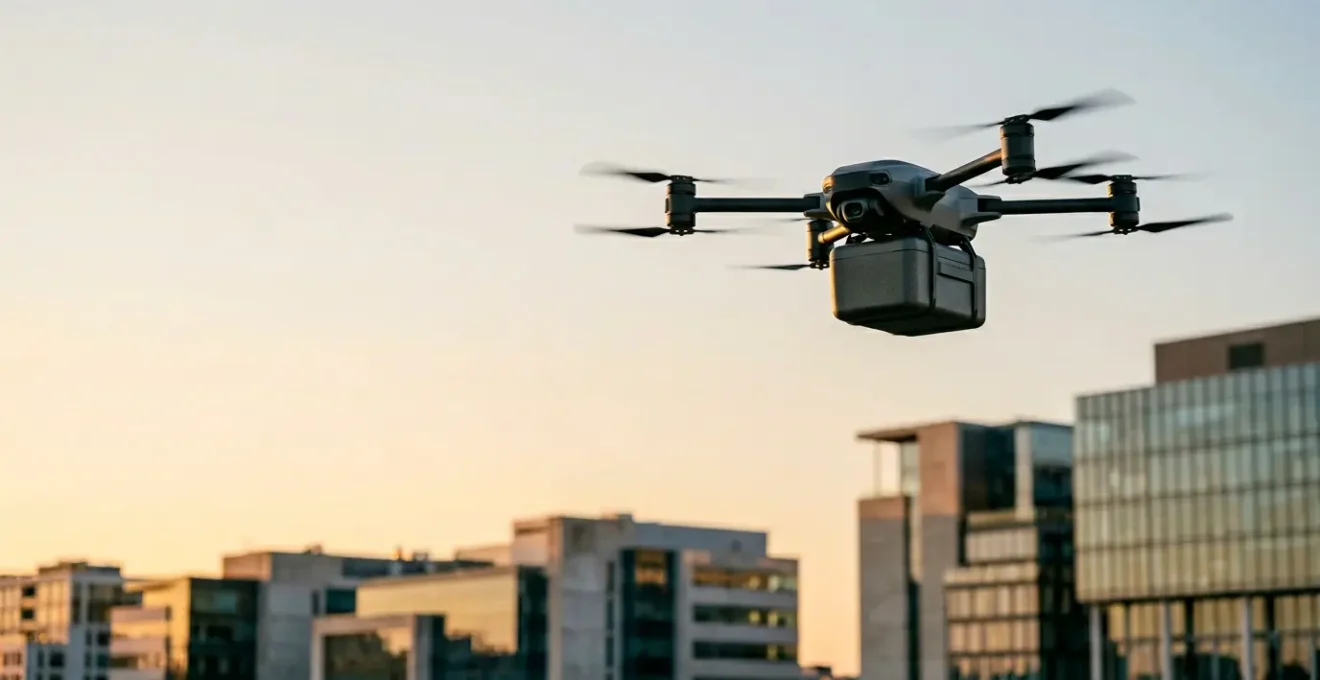
For a small business, successful drone delivery is not a technology acquisition problem; it is a rigorous exercise in operational liability management.
- Regulatory compliance, particularly securing a Beyond Visual Line of Sight (BVLOS) waiver, requires a comprehensive, documented safety case, not just advanced hardware.
- Liability is not singular; it is a chain that extends from the operator to the hardware manufacturer and software provider, necessitating robust insurance coverage.
Recommendation: Before investing in hardware, focus on developing a thorough operational safety plan and consulting with an insurance provider to understand your specific liability exposure.
For local business owners, the promise of drone delivery—bypassing traffic to deliver goods faster and cheaper—is compelling. The vision of a pharmacy sending urgent medication across town or a restaurant delivering hot food to a nearby suburb seems within reach. This technological leap forward is often framed around the capabilities of the drones themselves: their speed, range, and carrying capacity. However, from a regulatory and legal standpoint, this perspective is dangerously incomplete.
The central challenge is not whether a drone *can* fly from point A to point B, but whether it can do so within a complex, multi-layered framework of federal, state, and local regulations. The true barrier to entry for a small business is not the technology itself, but the immense burden of proving safe, reliable operation to authorities and insurers. This requires a shift in mindset from being a simple end-user of technology to becoming a de facto aviation operator, with all the legal responsibilities that entails.
This article deconstructs the legal and operational realities behind launching a drone delivery service. We will move beyond the hype to provide a prudent, juridical assessment of the core challenges: the economic justification, the critical process of obtaining waivers, the technological choices that impact reliability, and the inescapable questions of airspace management and liability. The goal is to equip you, the business owner, with a realistic framework for evaluating if this innovative step is, in fact, legally feasible for your operations.
To navigate this complex topic, this guide breaks down the essential legal and operational considerations you must address. The following sections provide a structured analysis of each critical component, from initial cost-benefit analysis to the ultimate question of liability.
Summary: Drone Delivery Legal & Operational Framework
- Why Drones Are 60% Cheaper Than Vans for Last-Mile Delivery?
- How to Obtain a Beyond Visual Line of Sight Waiver?
- Camera vs Radar: Which Sensor Works Best for Drones in Rain?
- The Airspace Management Error That Could Ground Your Fleet
- How to Swap Drone Batteries in Under 2 Minutes to Maintain Uptime?
- How to Use AI to Reduce Robot Travel Time by 20%?
- How to Access “Black Box” Data After an Autonomous Vehicle Crash?
- Who Is Liable When a Self-Driving Car Chooses to Crash?
Why Drones Are 60% Cheaper Than Vans for Last-Mile Delivery?
The primary business driver for adopting drone delivery is the potential for significant operational cost reduction. Unlike ground vehicles, drones are not constrained by road networks, traffic congestion, or the high variable costs associated with fuel and driver hours for small, frequent deliveries. Industry analysis confirms this, suggesting that drone delivery can have 40% to 70% lower operating costs compared to traditional vehicle-based methods. This efficiency stems from a more direct route and the lower energy consumption of an electric drone versus an internal combustion engine van for a single-parcel trip.
However, these figures must be contextualized. The most substantial savings are realized under specific conditions. A revealing study on delivery route optimization provides a concrete example. Research using a real-world road network found that depot-based drone delivery resulted in up to 60 percent cost savings compared to truck-only options, but specifically when servicing low-demand customers in smaller geographic areas. The average cost per parcel in this optimized model was a remarkably low $1.12. This highlights that drones are not a universal replacement for vans but are a highly efficient tool for a particular logistical niche: low-weight, high-frequency deliveries over short to medium distances.
For a small business owner, this means the economic viability depends entirely on your delivery patterns. A pharmacy delivering a single prescription or a restaurant sending a meal to a customer are prime use cases. The cost savings are less about replacing your entire delivery fleet and more about augmenting it with a specialized tool for the most inefficient part of your current operation—the “last mile.”
How to Obtain a Beyond Visual Line of Sight Waiver?
For any drone delivery operation to be commercially viable, it must operate Beyond Visual Line of Sight (BVLOS). This capability requires a specific waiver from the Federal Aviation Administration (FAA) under Part 107 rules. Obtaining this waiver is arguably the single greatest regulatory hurdle for a small business. The FAA’s primary concern is safety, and the onus is on the operator to prove that their operation will not pose an undue risk to other aircraft or people on the ground. This proof is submitted in the form of a comprehensive “Safety Case.”
A successful Safety Case is not merely a matter of filling out a form; it is a detailed technical and procedural dossier. It must convincingly demonstrate a robust system for risk mitigation. The core components include demonstrating that your drone is equipped with technology to detect and avoid other aircraft, typically with a minimum range of three nautical miles. Furthermore, your application must present a meticulous flight plan that accounts for all airspace classes, temporary flight restrictions, and pre-flight hardware checks. Most critically, it must include detailed contingency plans for every conceivable in-flight failure, from loss of command-and-control signal to motor failure.
Finally, the FAA requires evidence of a rigorous pilot training and evaluation program. Even in a highly automated system, a certified Remote Pilot in Command (RPIC) must be able to intervene. The entire argument is a lengthy, detailed narrative, and operators should be prepared for a significant administrative process. According to a 2019 report, the average review time is 90 days, assuming the initial application is complete and compelling.
Your Action Plan: Preparing the BVLOS Safety Case
- Map Your Operational Airspace: Identify all potential flight paths, noting controlled airspace, airports, schools, parks, and other sensitive areas. List all potential ground risks.
- Document Your Technology Stack: Inventory every piece of hardware and software, from the drone’s detect-and-avoid sensors to the fleet management platform. Obtain technical specifications for each.
- Draft Contingency Protocols: For each identified risk (e.g., GPS loss, battery failure, uncooperative aircraft), write a step-by-step emergency procedure. This includes “lost link” protocols and designated emergency landing zones.
- Formalize Your Training Program: Document the curriculum for your Remote Pilots in Command (RPICs), including initial training, recurrent training, and specific performance evaluations for emergency scenarios.
- Assemble Your Safety Case Narrative: Consolidate all documentation into a single, cohesive argument that demonstrates your operation meets or exceeds an equivalent level of safety to crewed aircraft.
Camera vs Radar: Which Sensor Works Best for Drones in Rain?
A key component of the BVLOS Safety Case is the drone’s ability to sense and perceive its environment under all expected operational conditions. This is particularly critical for weather. While sunny, clear days pose little challenge, a commercial delivery service must be able to operate reliably in adverse weather, such as rain. This makes the choice of sensor technology a crucial decision rooted in risk management.
The two primary sensor types for airborne detect-and-avoid systems are optical cameras and radar. While cameras are inexpensive and provide high-resolution data in ideal conditions, their performance degrades significantly in rain, fog, or low light. Raindrops on a lens can distort or obscure the image, and heavy precipitation can create a “wall” of visual noise, effectively blinding the system. Relying solely on cameras introduces a significant operational vulnerability tied directly to weather forecasts.
From a legal and safety perspective, radar is the superior choice for all-weather operations. Radar systems function by emitting radio waves and analyzing the reflected signals. These waves are largely unaffected by rain, fog, or darkness, allowing the drone to consistently detect obstacles and other aircraft regardless of most weather conditions. While radar sensors are traditionally more expensive and may offer lower resolution than cameras, their reliability and operational consistency are paramount. For an FAA waiver application, demonstrating the use of a weather-resilient sensor like radar strengthens the Safety Case by proving that your risk mitigation strategy is not limited to fair weather.
The Airspace Management Error That Could Ground Your Fleet
Beyond the initial waiver, the day-to-day operation of a drone fleet requires constant, vigilant airspace management. The single most common and potentially costly error is a failure to comply with Temporary Flight Restrictions (TFRs). A TFR is a regulatory action that temporarily restricts aircraft operations within a defined area. These can be “popped-up” with little notice for a wide variety of reasons, including major sporting events, concerts, presidential visits, disaster response, or wildfires.
For an automated drone fleet operating on pre-programmed routes, a TFR that suddenly appears over its operational area presents a critical legal and safety risk. It is the operator’s absolute responsibility to remain aware of and avoid all active TFRs. The FAA mandates that pilots check for Notices to Airmen (NOTAMs), which include TFRs, before every flight. For a drone business, this means integrating a real-time TFR data feed into your fleet management software is not an option—it is a foundational compliance requirement. Furthermore, compliance must be audited at the federal, state, and even local levels, as a federally-approved flight path can still violate a municipal ordinance, such as a ban on overflying a city park or school.
Failure to comply carries severe penalties. As the Federal Aviation Administration explicitly warns, the consequences are not trivial. This official guidance underscores the gravity of an incursion:
Pilots who violate TFRs can face sanctions ranging from warnings or fines to certificate suspensions or revocations.
– Federal Aviation Administration, FAA Temporary Flight Restrictions Guidance
For a business, a certificate revocation would mean the immediate and total grounding of the entire fleet, representing a catastrophic loss of investment.
How to Swap Drone Batteries in Under 2 Minutes to Maintain Uptime?
Operational uptime is the lifeblood of any delivery service. For drones, the primary constraint on uptime is battery life, which dictates range and flight duration. The question of how to swap batteries quickly is not a manual handling problem, but a high-level strategic decision about network design and capital investment. A business owner has two fundamental models to consider: a centralized depot with manual swaps or a distributed network of automated swapping stations.
The first model, a centralized depot, is the most straightforward to implement. Drones return to a single base of operations after each delivery, where a human operator manually swaps the depleted battery for a fresh one. This approach has a lower initial capital expenditure (CapEx) as it doesn’t require building expensive, automated infrastructure. However, it has a higher operational expenditure (OpEx) due to labor costs and is less scalable. The drone’s operational radius is strictly limited to half of its maximum round-trip range from that single point, which may not be sufficient for covering a large service area.
The second model involves creating a network of automated swapping stations at strategic locations throughout the service area. A drone can land at one of these stations, where a robotic system automatically replaces its battery before it continues its mission. This approach dramatically extends the effective operational range and minimizes downtime between jobs, creating a true delivery network. However, it requires a massive upfront investment in real estate and technology. Each station is a complex piece of robotics that must be maintained. This model is better suited for high-volume, wide-area operations and represents a much greater financial commitment.
How to Use AI to Reduce Robot Travel Time by 20%?
To maximize the return on investment from a drone fleet, every second of flight time must be optimized. Artificial intelligence (AI) is the core technology that transforms a group of individual drones into a highly efficient, coordinated delivery system. The goal of reducing travel time by a figure such as 20% is achieved not by making the drones fly faster, but by making the entire system operate “smarter” through several layers of AI-driven optimization.
The most significant application is in dynamic route optimization. AI algorithms solve a version of the classic “Traveling Salesperson Problem” in real-time, calculating the most efficient route for each drone based on multiple factors: delivery locations, package priorities, and current battery levels across the fleet. The system can batch orders intelligently, assigning a single drone to multiple nearby drop-offs to minimize empty “return to base” flights. This is a far more complex and efficient process than simply assigning the closest drone to the next available order.
Secondly, AI plays a crucial role in predictive fleet management. By analyzing telemetry data from every flight, machine learning models can predict when a component, such as a motor or battery, is likely to fail. This allows the operator to schedule maintenance proactively before a failure occurs in the field, preventing costly downtime and mission aborts. Finally, AI contributes to airspace safety by managing fleet-wide deconfliction. It ensures that multiple drones operating in the same area maintain safe separation from each other and can dynamically re-route the entire fleet to avoid a newly emerged obstacle or a pop-up TFR, a task that would be impossible to manage manually at scale.
How to Access “Black Box” Data After an Autonomous Vehicle Crash?
In the event of an incident or crash, a swift and thorough investigation is a legal and operational necessity. A common misconception is that a drone has a single, easily accessible “black box” like a commercial airliner. In reality, the critical flight data is often distributed across multiple systems. This “Event Data Recorder” (EDR) can include flight path telemetry stored on the drone, command-and-control signals logged by the ground station, communication logs from the software provider’s cloud, and even onboard video feeds. Accessing this fragmented data is a major challenge that must be addressed before the first flight.
From a legal standpoint, you cannot assume you will have the right to access this data after a crash. Data access rights must be established contractually from the outset with every party in your operational chain: the drone manufacturer, the fleet management software provider, the communication service, and your insurer. These contracts must explicitly define who owns the data, who can access it post-incident, and what the legally defensible chain of custody will be for preserving it as evidence. Without these agreements in place, a manufacturer could refuse to provide crucial data, severely hampering your ability to determine the root cause of a failure and defend against liability claims.
The best practice, borrowed from the airline industry, is to implement a proactive Flight Data Monitoring (FDM) program. This involves systematically collecting and analyzing telemetry data from all flights, not just those that end in an incident. By continually monitoring for anomalies, risky trends, or deviations from standard procedures, you can identify and correct safety issues before they lead to an accident. An FDM program is not only a powerful safety tool but also a powerful legal one, demonstrating to regulators and insurers that you have a mature, data-driven safety culture.
Key takeaways
- Drone delivery’s cost-effectiveness is highest for low-weight, high-frequency deliveries in small, targeted areas.
- Securing a BVLOS waiver is a legal and procedural challenge centered on a comprehensive, documented “Safety Case” that proves risk mitigation.
- Liability is a shared chain involving the operator, manufacturer, and software provider; robust aviation insurance is non-negotiable.
Who Is Liable When a Self-Driving Car Chooses to Crash?
The question of liability in autonomous systems is one of the most complex legal frontiers. When a delivery drone is involved in an accident causing property damage or injury, the question of “who is at fault?” does not have a simple answer. Unlike a scenario with a human driver, liability is not concentrated on a single individual but is distributed across a “chain of liability.” A small business operating a drone fleet must be prepared to navigate this complex landscape, where fault can be attributed to multiple parties.
The operator (your business) can be held liable for negligence in areas under your direct control, such as inadequate pilot training, improper maintenance, or failure to follow established safety procedures. However, the drone manufacturer may be culpable if the accident was caused by a hardware defect or a fundamental design flaw. Similarly, the provider of the autonomy or fleet management software could be found liable for algorithmic errors, software bugs, or inadequate testing that led to the incident. In some specific scenarios, even the customer could share a portion of the liability if they provided incorrect delivery information or knowingly created a hazardous condition at the drop-off location.
Given this distributed risk, the primary tool for mitigation is insurance. Standard business liability policies are insufficient; you require specialized aviation insurance. Industry experts recommend that drone delivery operations carry at least $1 million in aviation liability coverage, with annual premiums varying based on the scale and risk profile of the operation.
The following table, based on recommendations for commercial drone operations, outlines the essential policies a business must consider to protect itself against the significant financial exposure associated with an accident.
| Insurance Type | Coverage | Estimated Cost | Requirement Level |
|---|---|---|---|
| Aviation Liability | Third-party injury or property damage | $750-$2,500/year for $1M coverage | Critical – Minimum $1M recommended |
| Hull Insurance | Physical damage to your drone | 5-10% of drone’s insured value/year | Highly Recommended |
| Workers’ Compensation | On-the-job injuries for hired pilots | Varies by state | Mandatory if hiring pilots (most states) |
Before committing capital to drone hardware, the first and most critical investment is in legal and regulatory consultation. Building a robust operational plan and securing the right insurance coverage is the true foundation of a viable drone delivery business.