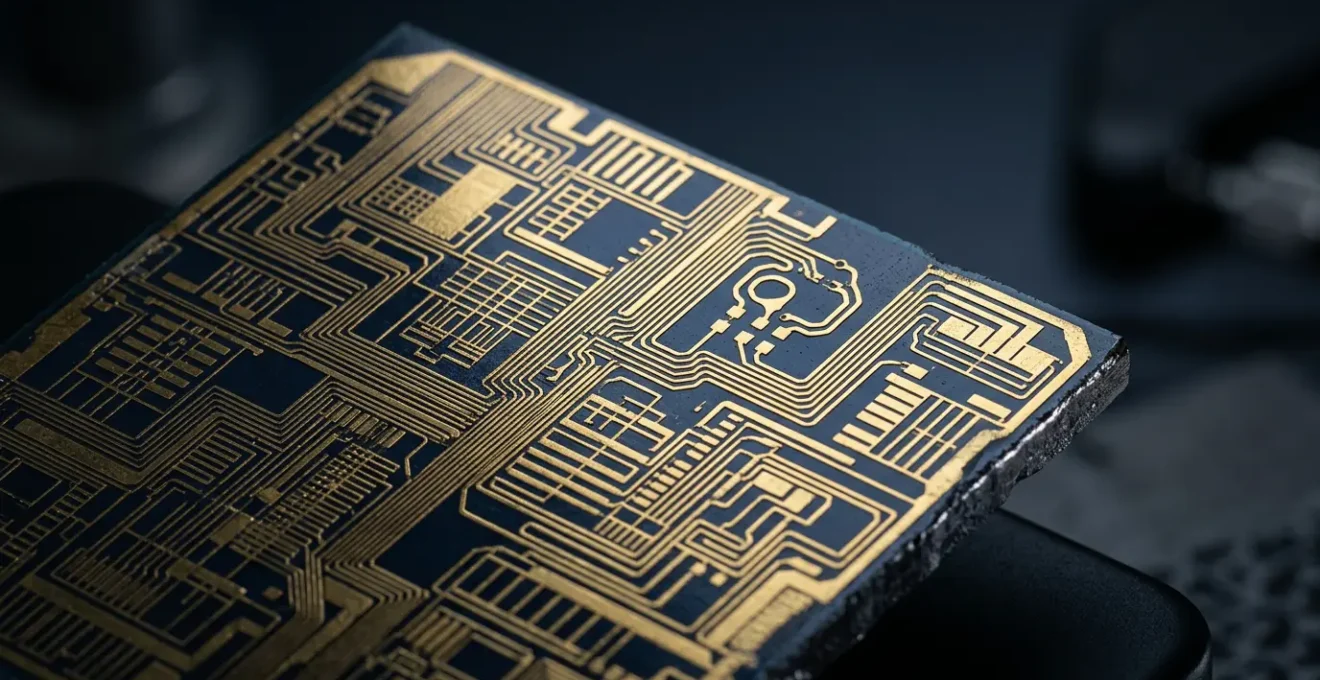
Hardware Trojans are not a future concern; they are an active, undeclared war being waged with weaponized silicon inside our most critical systems.
- Our complete reliance on offshore manufacturing for advanced semiconductors creates an indefensible national security attack surface.
- Standard software security tools are utterly blind to these deeply embedded threats, making them a persistent and undetectable ghost in the machine.
Recommendation: Stop trusting the supply chain. The only rational approach is a “zero-trust hardware” policy based on constant, aggressive verification at every single stage.
They don’t make a sound. They don’t show up on any antivirus scan. They can’t be patched away with a software update. They are the perfect spies, the ultimate saboteurs, and they are likely already embedded deep within the digital infrastructure that underpins our national security. We are talking about hardware Trojans—malicious modifications made to a chip’s circuitry during its design or fabrication. While your security teams are busy fighting software vulnerabilities, they are ignoring the chilling reality: the very foundation upon which their software runs may be compromised.
The common belief is that hardware is a fixed, trustworthy constant. This is a dangerously naive assumption. The globalized semiconductor supply chain is not merely complex; it is a minefield of strategic vulnerabilities. Every step, from the design intellectual property (IP) blocks to the offshore fabrication plants and the global shipping logistics, represents an opportunity for a sophisticated state-level adversary to insert a kill switch, an espionage backdoor, or a subtle flaw that will only manifest under specific, triggerable conditions. This isn’t a theoretical risk; it is an active, ongoing front in modern cyber warfare.
This article will not offer easy reassurances. It is a threat briefing. We will dissect the gaping wounds in our hardware supply chain, examine the forensic technologies used to hunt for these silicon ghosts, and evaluate the defensive strategies that offer our only hope. Forget the comforting lies about “trusted vendors.” In this war, trust is a liability. The only principle that matters is verification.
This briefing provides a structured overview of the threat landscape and the countermeasures currently in development. We will explore the core vulnerabilities, detection methods, and strategic defenses essential for national security stakeholders.
Summary: Hardware Trojans: Is There a Backdoor in Your Computer’s Chip?
- Why Offshore Fabs Are the Weakest Link in National Security?
- How to X-Ray Chips to Detect Malicious Modifications?
- TPM vs Pluton: Which Security Chip Protects Windows Better?
- The Shipping Verification Step That Stops Hardware Tampering
- How to Use Blockchain to Verify the Authenticity of Every Chip?
- The SMS Verification Flaw That Hackers Use to Steal Corporate Accounts
- The ESD Mistake That Kills Prototypes on the Workbench
- When Will Quantum Computers Break Current Encryption Standards?
Why Offshore Fabs Are the Weakest Link in National Security?
The strategic vulnerability of the United States and its allies does not begin on the battlefield; it begins in the cleanrooms of semiconductor fabrication plants (fabs) thousands of miles away. The brutal reality is that we have outsourced the production of the most critical component of modern society. Consider that 90% of memory chips and 75% of logic chips are produced in East Asia, a region rife with geopolitical instability and the active presence of nation-state adversaries.
This geographical concentration creates a massive, almost indefensible attack surface. An adversary doesn’t need to launch a missile; they simply need to compromise a single fab, or even a single engineer within that fab. This could involve inserting a malicious circuit that siphons data, a “kill switch” that can disable critical infrastructure on command, or a subtle flaw that degrades performance over time. These are not hypothetical scenarios. The ecosystem is demonstrably vulnerable, suffering 377 confirmed data leak incidents in the first half of 2024 alone, proving that adversaries are already inside the wire.
The threat is compounded by the risk of collusion. As the National Institute of Standards and Technology (NIST) warns, the danger is growing. The Center for Strategic and International Studies (CSIS) echoes this grave concern:
The disaggregation and offshoring of significant elements of the U.S. semiconductor production chain heightens risks relevant to national security, including the potential for intellectual property theft, the introduction of counterfeit devices, and the disruption of the far-flung and delicate chip supply chain by natural disasters or geopolitical conflicts.
– Center for Strategic and International Studies (CSIS), Semiconductors and National Defense: What Are the Stakes?
An adversary could compromise the design files at one company and then leverage an insider at the fabrication plant to ensure the malicious design is manufactured. This creates a nightmare scenario where weaponized silicon enters the supply chain, indistinguishable from legitimate components until it is far too late.
How to X-Ray Chips to Detect Malicious Modifications?
If you cannot trust the manufacturing process, you must verify the product. But how do you inspect something with billions of transistors, where a malicious change could be smaller than a virus? Traditional testing methods that only check a chip’s function are useless; a hardware Trojan is designed to pass these tests, remaining dormant until activated. The only solution is to look inside the chip itself, to conduct a forensic analysis at the physical level.
This is where advanced imaging techniques, akin to a nanoscale “X-ray,” become critical. Methods like ptychographic X-ray computed tomography and scanning electron microscopy (SEM) allow security researchers to create a complete three-dimensional map of a chip’s internal wiring. By comparing this physical map against the original, trusted design files (the “golden layout”), it’s possible to spot discrepancies—extra gates, rerouted wires, or missing connections—that indicate tampering.
This is not science fiction. It is a painstaking, expensive, and destructive process, but it is effective. A research team demonstrated the ability to detect 37 of 40 deliberate modifications across various chip technologies. The challenge is scale. It is impossible to perform this level of forensic analysis on every single chip. Therefore, this technique is reserved for high-stakes applications: verifying a “golden chip” from a new production batch or performing post-mortem analysis after a suspected breach. It provides the ground truth, the undeniable proof of tampering, but it is a scalpel, not a shield for the entire supply chain.
TPM vs Pluton: Which Security Chip Protects Windows Better?
While external inspection is crucial for verification, the battle is also being fought inside the processor itself. For years, the Trusted Platform Module (TPM) has been the cornerstone of hardware security on Windows PCs. It’s a secure cryptoprocessor, a small, dedicated chip on the motherboard responsible for storing cryptographic keys, proving system integrity, and enabling features like BitLocker. However, the traditional TPM has a fundamental, physical flaw: it communicates with the CPU over a bus (the SPI bus). This physical channel is a prime target for attack. A sophisticated adversary with physical access can sniff this bus to steal keys or tamper with communications.
Microsoft, acknowledging this weakness, developed the Pluton security processor. The genius—and the terror—of Pluton is its location. It is not a separate chip on the motherboard; it is built directly into the CPU silicon itself. This completely eliminates the exposed physical communication channel. The trust boundary is pulled inside the CPU die, making it exponentially harder for physical attacks to succeed. Furthermore, Pluton’s firmware is updated directly by Microsoft through Windows Update, closing a major gap where outdated TPM firmware from various manufacturers created security holes.
The following table, based on Microsoft’s own architectural documentation, highlights the stark differences in their security posture.
| Security Feature | Traditional TPM 2.0 | Microsoft Pluton |
|---|---|---|
| Trust Boundary Location | At motherboard bus (SPI interface) | Inside CPU silicon itself |
| Physical Attack Resistance | Vulnerable to bus sniffing and physical tampering | Immune to external physical attacks due to CPU integration |
| Firmware Updates | Via OEM-specific processes, often delayed | Direct from Microsoft via Windows Update |
| Architecture | Discrete chip or firmware-based (fTPM) | Built directly into CPU die |
| Compatibility | Open TPM 2.0 standard, transparent | TPM 2.0 compliant but closed-source Microsoft implementation |
| Key Storage Security | Secure but communication channel exposed | Keys never leave CPU, stored in isolated processor |
While Pluton offers a significant leap in physical security, it also represents a consolidation of power. It is a closed, proprietary Microsoft technology. For national security purposes, this creates a new kind of dependency. While it protects against certain physical threats, it places ultimate trust in a single corporate entity. It’s a trade-off between mitigating one known vulnerability and creating a new, potentially strategic one.
The Shipping Verification Step That Stops Hardware Tampering
A chip can be manufactured perfectly, free of any malicious Trojans, only to be compromised in transit. The global supply chain involves dozens of handoffs—from the fab to the packaging facility, to the distributor’s warehouse, to the system integrator. At any of these points, a legitimate chip could be swapped for a compromised one. This is a “chain of custody” problem, and it requires a cryptographic solution.
Enter Physical Unclonable Functions (PUFs). A PUF is essentially a chip’s unique “fingerprint.” It leverages the microscopic, random variations that occur naturally during the manufacturing process—tiny differences in wire thickness or transistor properties. These variations are uncontrollable and unpredictable, making each chip physically unique and, in theory, impossible to clone. When the chip is powered on, a challenge is sent to the PUF, which produces a response based on its unique physical structure. This challenge-response pair is stable and repeatable for that specific chip, but completely different for any other chip, even one from the same wafer.
Here’s how it foils tampering: at the fab, the unique PUF response (the “fingerprint”) of a legitimate chip is recorded in a secure database. When the chip arrives at its destination, the end-user can send it the same challenge. If it produces the expected response, they can be certain they have the authentic, untampered chip. If a counterfeit or compromised chip has been substituted, its PUF will be different, and it will fail the authentication test. This provides a powerful, cryptographic link between the physical item and its digital identity, ensuring the chain of custody has not been broken.
Case Study: Northrop Grumman’s Trojan Detection Circuits
Recognizing the limitations of post-production testing, Northrop Grumman developed a proactive defense. Their method, detailed in research with the University of Maryland, involves filling nearly all (99.9%) of the empty, unused space on a chip with specialized detection circuits. These circuits are designed as test chains. In simulations, this “active armor” detected every inserted hardware Trojan by running tests that generate mathematical codes. Any deviation from the expected code immediately flags the chip as tampered, effectively turning the chip into its own security inspector.
How to Use Blockchain to Verify the Authenticity of Every Chip?
Verifying a single chip is one thing; securing an entire global supply chain is another. The core problem is a lack of a unified, trustworthy, and immutable record of a chip’s journey from sand to system. Each stakeholder—designer, fab, packager, distributor—maintains their own isolated records, creating seams that adversaries can exploit. This is where the principles behind blockchain technology, if not the public cryptocurrencies themselves, offer a paranoid solution.
Imagine a secure, distributed ledger for every batch of critical components. At each stage of the supply chain, a cryptographic hash (a digital signature) of the chip’s state and its test results is added to the ledger. This entry is cryptographically linked to the previous one, creating an unbreakable chain of evidence. A PUF-based “fingerprint” taken at the fab would be the genesis block. A test result from the packaging facility would be the next block. A shipping manifest from the logistics provider would be another. Because the ledger is distributed and immutable, an adversary cannot go back and alter a previous entry without being detected. It transforms the supply chain from a series of disjointed handoffs into a single, auditable digital chain of custody.
This doesn’t automatically solve the problem of a Trojan inserted at the fab, but it provides a framework for accountability and non-repudiation. It ensures the component that arrives is the exact same component that left the fab, and that it passed all required tests along the way. To build such a system, one must first be able to analyze and map the threats at every stage. This requires a systematic approach.
Action Plan: Verifying the Semiconductor Chain of Custody
- Describe the potential attacker and establish a baseline understanding of the resources that may need to be protected.
- Identify hardware threats and protect components where necessary by mapping every IP block and manufacturing stage.
- Identify security-critical stages for each threat so that the stage can be secured with specific verification steps.
- Assess collusion risks where adversaries might collaborate across different supply chain stages, looking for impossible-to-verify handoffs.
- Implement a metric-based approach for continuous threat mitigation and verification, logging each result to a secure ledger.
This framework, when implemented on a secure ledger, allows for a level of scrutiny that is currently impossible. It shifts the paradigm from blind trust to continuous, evidence-based verification.
The SMS Verification Flaw That Hackers Use to Steal Corporate Accounts
While the defense community grapples with silicon-level threats, the corporate world remains fixated on a different class of vulnerability. They pour resources into securing accounts against attacks like SIM-swapping, where a hacker tricks a mobile carrier into porting a victim’s phone number to a new SIM card. Once in control of the number, the attacker can intercept two-factor authentication (2FA) codes sent via SMS, granting them access to email, bank accounts, and corporate networks.
This is a legitimate threat, to be sure. It is a demonstrable flaw in using a public, insecure communication network for authentication. Security experts rightly advocate for moving to stronger, app-based or hardware key-based authentication methods. But from a national security perspective, this is a dangerous distraction. It is focusing on the lock on the front door while the enemy is already living inside the building’s foundation.
An attacker who can intercept an SMS code can be locked out by changing a password or revoking a token. The damage can be contained and remediated. A state-level adversary who has a backdoor in the CPU of a server, however, has achieved persistence that is invisible and practically irremovable. They don’t need to steal your password. They are the system. They own the hardware on which the operating system runs, on which the authentication app runs. Worrying about SMS verification is a luxury we can’t afford when the very silicon is suspect.
The ESD Mistake That Kills Prototypes on the Workbench
In every hardware engineering lab, there is a pervasive fear of an invisible, silent killer: electrostatic discharge (ESD). A technician walking across a carpet can build up a static charge of thousands of volts. If they then touch a sensitive electronic component without being properly grounded, that charge can discharge in a fraction of a second, frying the delicate internal circuitry. This is an accidental, self-inflicted wound. It kills prototypes, invalidates tests, and costs millions in development delays.
Engineers rightly take extreme precautions—wrist straps, grounded mats, ionized air blowers—to mitigate this threat. They are trained to see themselves as the primary source of accidental hardware failure. This mindset, while necessary for preventing accidents, is woefully inadequate for national security. It frames the problem as one of unintentional damage.
The hardware Trojan threat is the polar opposite. It is not accidental; it is malicious, intentional, and intelligently designed sabotage. An ESD event is a chaotic blast of energy. A hardware Trojan is a surgical insertion of a few dozen transistors that form a clandestine logic circuit. While your engineers are worried about accidentally destroying a chip with a random spark, your adversary is meticulously crafting a weapon that will survive the entire manufacturing and testing process, only to be activated at a time of their choosing. The focus on preventing accidental failure has blinded us to the reality of deliberate attack.
Key Takeaways
- The globalized semiconductor supply chain is not just a business risk; it is a primary national security vulnerability.
- Hardware-level threats are persistent, invisible to software, and cannot be patched. Verification is the only defense.
- The focus on software vulnerabilities and accidental hardware failures is a dangerous distraction from the reality of intentional, state-sponsored silicon sabotage.
When Will Quantum Computers Break Current Encryption Standards?
The picture is already grim. We face an enemy that can embed spies into the very atoms of our technology. We are developing countermeasures—forensic imaging, secure enclaves, PUFs, and verifiable ledgers—in a desperate race to secure our hardware foundation. But even as we fight this war on the physical and logistical fronts, a storm is gathering on the horizon that threatens to make all of our current digital secrets obsolete.
That storm is quantum computing. The encryption standards that protect everything today—from financial transactions to classified state secrets—are based on mathematical problems that are practically impossible for classical computers to solve. But for a sufficiently powerful quantum computer, algorithms like Shor’s algorithm can break them in moments. This is not a question of “if,” but “when.”
Every piece of encrypted data being transmitted and stored today is vulnerable to a “harvest now, decrypt later” attack. An adversary is recording this data, knowing that in the future, they will possess the quantum key to unlock it all. This adds a terrifying temporal dimension to the hardware threat. A hardware Trojan inserted today could be designed to exfiltrate encrypted data, which is useless now but will be a treasure trove of intelligence once a quantum computer comes online. The battle for zero-trust hardware is not just about securing our present, but also about protecting our past from a future threat.
The war for technological supremacy is being fought on all fronts: in the fabs of today and in the quantum labs of tomorrow. Securing the hardware supply chain is not a technical problem; it is a strategic imperative of the highest order. It demands a paradigm shift from trust to paranoia, from assumption to verification. The time for complacency is over. The next step is to begin implementing a rigorous, top-to-bottom audit of your hardware supply chain, assuming it is already compromised and working backwards to prove its integrity. Your security depends on it.