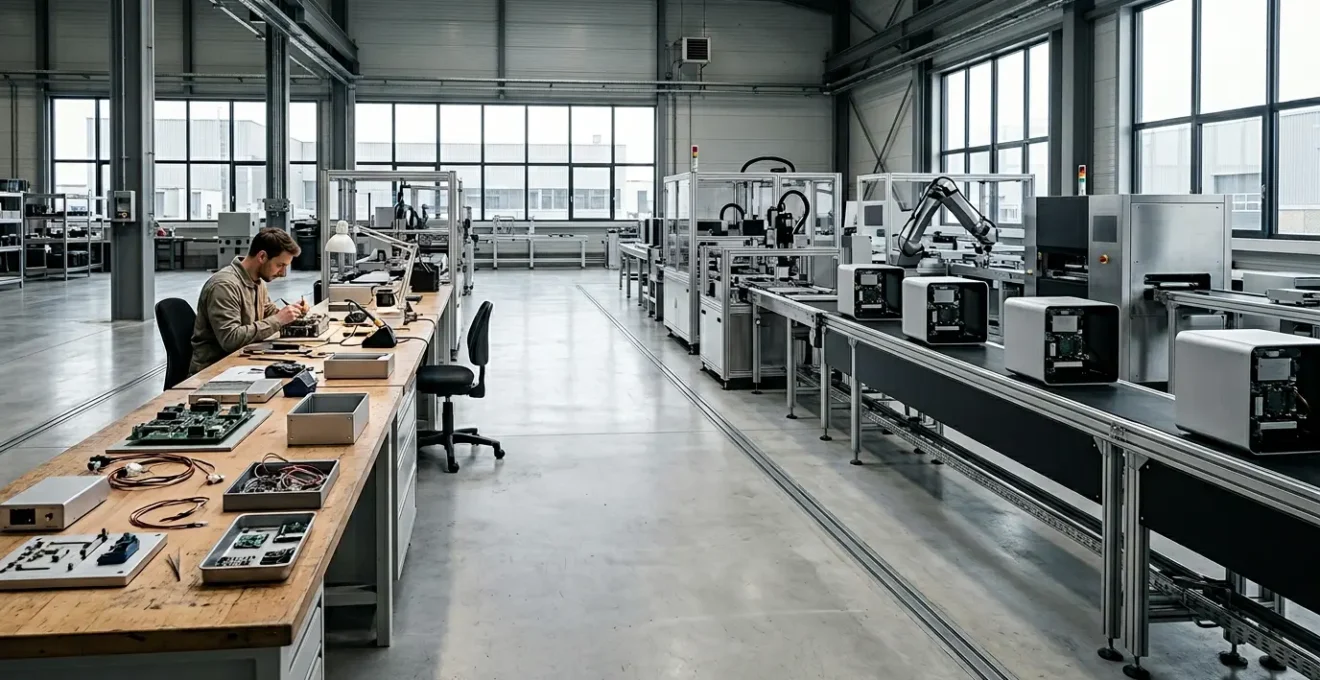
The key to a fast production launch is not accelerating the build; it’s front-loading the resolution of manufacturing problems into your earliest prototypes.
- Treat every prototype as a tool to answer a specific manufacturing question, not just to prove a feature works.
- Focus on de-risking your supply chain, legal exposure, and tooling costs long before your design is finalized.
Recommendation: Shift your mindset from a linear “design then build” sequence to a parallel process where manufacturing validation happens at every design stage.
For many hardware startup founders, the journey from a working prototype to a mass-produced product feels like a final sprint. In reality, it’s a treacherous chasm known as the ‘Valley of Death’, where countless promising products fail. The common advice revolves around finding a good factory or creating a “Design for Manufacturing” (DFM) plan. While correct, this advice misses the fundamental reason for failure: treating production as a final step rather than an integral part of the design process from day one.
The conventional wisdom suggests you perfect your design and then “hand it off” for manufacturing. This linear thinking is a trap. It creates a massive risk profile where a single unforeseen issue—a component shortage, a tooling incompatibility, a legal oversight—can derail your entire timeline and budget. The secret to navigating this valley isn’t to run faster; it’s to build bridges as you go, de-risking each step of the manufacturing process long before you commit to scale.
But what if the true key to speed wasn’t about accelerating the final build, but about a radical shift in how you approach prototyping itself? This guide abandons the linear fantasy and presents a process-driven, realistic framework. We will explore how to make strategic decisions on prototyping methods, legal protections, and component sourcing that answer critical manufacturing questions early, turning your prototype from a simple proof of concept into a powerful de-risking tool. This is how you don’t just survive the Valley of Death—you bypass it.
To navigate this complex transition, this article breaks down the essential, process-oriented decisions you need to make. The following sections provide a clear roadmap, covering everything from the financial impact of design changes to building a resilient supply chain.
Contents: A Founder’s Guide to Crossing the Manufacturing Valley of Death
- Why One Late Design Change Can Double Your Prototyping Budget?
- 3D Printing vs CNC Machining: Which Is Best for Your Functional Prototype?
- The NDA Clause You Must Include When Sending Files to Overseas Factories
- Arduino vs Raspberry Pi: Which Is Better for an Industrial Proof of Concept?
- How to Source Components That Won’t Go Obsolete Next Year?
- How to Launch Your MVP in 90 Days Without Blowing the Budget?
- Level 5 Autonomy: Why Are We Still 10 Years Away?
- How to Design PCBs That Are Immune to Global Chip Shortages?
Why One Late Design Change Can Double Your Prototyping Budget?
The most dangerous phase for a hardware startup’s budget is the transition from a functional prototype to a production-ready design. A common mistake is underestimating the impact of “minor” adjustments made late in the game. These changes trigger a cascade of hidden expenses known as Non-Recurring Engineering (NRE) costs. NRE covers the one-time costs to research, design, develop, and test a new product. This includes creating molds, tooling, jigs, and test fixtures.
When you change a design after tooling has been created, you often have to pay for it all over again. A change as simple as moving a screw hole can require a multi-thousand-dollar modification to a steel injection mold. As OpenBOM’s engineering analysis highlights, “Design choices made early on can have significant implications for production costs and timelines.” This is the core of manufacturing-aware design: understanding that every decision, from material choice to enclosure shape, has a downstream cost.
The financial impact is not trivial. For small-batch production, NRE can be a dominant expense. In fact, NRE costs can represent up to 50% of total expenses in the initial production run. Doubling this cost because of a late design change is what sinks many startups. The solution is a “design freeze”—a point in the development process after which changes are either prohibited or subject to a rigorous and costly review process. This forces discipline and front-loads critical decision-making.
3D Printing vs CNC Machining: Which Is Best for Your Functional Prototype?
Choosing the right prototyping method is a critical strategic decision, not just a technical one. The two most common high-fidelity methods are 3D printing (additive) and CNC machining (subtractive). The choice is not about which is “better,” but which best serves your goal of de-risking the manufacturing process. Each method answers different questions about your product’s viability at scale.
3D printing is unparalleled for speed and geometric complexity. If your primary goal is to test form, fit, and ergonomic feel quickly, it’s the ideal choice. You can have a physical part in hand within hours, allowing for rapid iteration on the user-facing aspects of your design. However, its material properties are often not representative of a final production part.
CNC machining, by contrast, creates parts from a solid block of production-grade material (like aluminum or ABS plastic). The resulting prototype has the exact mechanical strength, weight, and surface finish of a mass-produced part. While slower and often more expensive for a single unit, a CNC prototype answers a crucial question: “Will this design hold up under real-world stress with production materials and processes?” It forces you to design with manufacturing constraints in mind from the beginning.
The following table breaks down the core trade-offs. Use it not to pick a “winner,” but to decide which manufacturing questions you need to answer most urgently.
| Factor | 3D Printing | CNC Machining |
|---|---|---|
| Best for Volume | Low volumes (under 10 units) | Higher volumes (100+ units) |
| Speed | Faster turnaround (24 hours possible) | Longer setup time required |
| Complexity | Excellent for complex geometries, lattice structures | Limited by tool access, better for straightforward designs |
| Material Strength | Variable (10-100% of native material properties) | Full native material strength |
| Precision | Good accuracy, challenging for tight tolerances | Superior dimensional accuracy, tight tolerances |
| Surface Finish | Requires post-processing for smooth finish | Smooth, production-grade finish achievable |
The NDA Clause You Must Include When Sending Files to Overseas Factories
When you’re ready to get quotes from overseas manufacturers, the first instinct is to send a standard Non-Disclosure Agreement (NDA). This is a critical mistake. A US-style NDA is often unenforceable in China and provides a false sense of security. What you need is a different, more powerful legal instrument: an NNN (Non-disclosure, Non-use, Non-circumvention) Agreement, drafted specifically for enforcement under Chinese law.
An NNN agreement goes far beyond a simple NDA.
- Non-Disclosure is similar to an NDA, preventing the factory from revealing your confidential information.
- Non-Use is the crucial addition: it prevents the factory from using your idea to create their own competing product, even if they change the design slightly.
- Non-Circumvention prevents the factory from identifying your suppliers and bypassing you to work with them directly.
This is not just legal theory; it’s a practical de-risking tool with real-world consequences.
Case Study: NNN Agreement Enforcement
Consider the case of a US company that engaged a Chinese manufacturer for a new electronic device. After sending detailed CAD files and schematics, they discovered the factory was planning to launch a near-identical product on a local e-commerce platform. Because they had a properly drafted NNN agreement governed by Chinese law, their legal position was strong. This allowed them to take swift action, issuing legal notices through a Chinese law firm that resulted in an immediate halt to the factory’s competing activities and an arbitration process for damages. Without the NNN, their US-based NDA would have been worthless.
To be effective, your NNN agreement must be written in Chinese, be governed by Chinese law, and include a clause for specific, pre-agreed financial penalties (liquidated damages) for any breach. This transforms it from a piece of paper into a weapon that Chinese courts can and will use to protect your intellectual property. It is an essential part of your manufacturing risk mitigation strategy.
Arduino vs Raspberry Pi: Which Is Better for an Industrial Proof of Concept?
In the world of electronic prototyping, Arduino and Raspberry Pi are the dominant platforms. Founders often ask which is “better” for their Proof of Concept (PoC), but this question misunderstands their fundamental difference. Choosing between them is a strategic decision about what you are trying to prove. An Arduino is a microcontroller: a component designed to execute a single, repetitive task with high reliability and real-time precision. A Raspberry Pi is a microprocessor running a full operating system: a small, versatile computer.
For an industrial PoC, the choice depends on the task. If you’re developing a simple sensor that reads temperature and transmits data, the low power consumption and deterministic, real-time performance of an Arduino is ideal. It excels at control tasks. If your product needs to run complex algorithms, manage a graphical user interface, or process data from multiple sources (like a security camera), the processing power and Linux-based OS of a Raspberry Pi are necessary. It excels at computation and connectivity tasks.
The table below outlines the core architectural and performance differences that should guide your decision. The key is to map your product’s core function to the platform’s strengths.
| Criteria | Arduino (Microcontroller) | Raspberry Pi (Microprocessor) |
|---|---|---|
| Architecture | Microcontroller (component of computer) | Full single-board computer (SBC) |
| Operating System | None (bare-metal code execution) | Full OS (typically Linux-based) |
| Power Consumption | Low-power, battery operation for months | Higher consumption, requires constant power |
| Processing Speed | 16-48MHz typical (up to 480MHz max) | 1.4-1.5GHz (40x faster than Arduino) |
| Real-time Performance | Deterministic, microsecond response | Non-deterministic due to OS interrupts |
| Ideal Use Case | Sensor nodes, simple control, real-time tasks | Edge computing, gateway, AI/ML inference, video processing |
| Programming Complexity | Simple (C/C++ in Arduino IDE) | Complex (requires Linux knowledge, Python/Node.js) |
| Unit Cost (Scale) | Lower cost enables large sensor networks | Higher cost, prohibitive for mass deployment |
However, thinking in terms of “A vs B” is a novice’s approach. As the IoT Architecture Team at Cyber Infrastructure Inc. notes in their analysis, a professional-grade architecture often uses both. They state that for enterprise solutions, the answer is often a hybrid approach, using Arduino-like microcontrollers for sensors and Raspberry Pi-like microprocessors for gateways. This “hub and spoke” model is a powerful, scalable, and resilient architecture for industrial applications.
How to Source Components That Won’t Go Obsolete Next Year?
One of the most insidious ways a hardware product can fail is not through a design flaw, but through a supply chain collapse. You finalize your design, build your prototypes, and start your first production run, only to find that a critical component on your Bill of Materials (BOM) is suddenly unavailable or has a 52-week lead time. This is not a hypothetical; it’s a common reality that can bankrupt a startup. Component lifecycle management is therefore a critical de-risking activity.
The solution is to adopt a “Component Longevity Mandate” early in the design phase. This means you don’t just select components based on their technical specifications and price; you must aggressively vet them for their long-term availability. This involves a strategic shift in how you design your product and manage your BOM. It’s about building resilience directly into the DNA of your product’s supply chain before a single unit is produced.
This isn’t about guesswork. It’s a formal process that can be implemented through a clear set of internal rules and by leveraging professional tools. You must design for flexibility and proactively seek out components that are built for the long haul. The following checklist provides a framework for building this resilience into your sourcing strategy.
Action Plan: Implementing a Component Longevity Strategy
- Prioritize Longevity Programs: Actively search for components from major manufacturers (e.g., Texas Instruments, STMicroelectronics) that are part of formal 10-15 year longevity programs for industrial applications.
- Enforce a Dual-Source Mandate: Make it a strict rule that no critical, single-source component is permitted on the final BOM without a pre-qualified, drop-in replacement. This includes having alternative package types ready.
- Utilize Supply Chain Intelligence: Adopt professional tools like SiliconExpert or IHS Markit to proactively analyze the lifecycle status, lead times, and multi-source availability of every BOM component before committing to the design.
- Engage Manufacturing Partners Early: Involve your contract manufacturer’s procurement team during the prototyping phase to vet your component choices against their real-world supply chain data and supplier relationships.
- Design for Component Flexibility: Instruct your PCB designers to create layouts with overlapping footprints that can physically accept multiple pin-compatible components from different vendors, reducing dependency on a single part number.
How to Launch Your MVP in 90 Days Without Blowing the Budget?
The pressure on hardware startups to launch quickly is immense. A 90-day timeline for a Minimum Viable Product (MVP) launch sounds like a dream, but it’s achievable if you redefine what an MVP is for. The goal is not a perfect, miniaturized version of your final product. The goal is to generate maximum validated learning about your customers and your manufacturing process with minimum effort. This is especially critical in hardware, where industry research shows as many as 90% of startups fail during the transition from prototype to production.
The key to a fast, budget-conscious launch is a Manufacturing-Aware MVP strategy. Instead of asking “What features should our MVP have?”, you should be asking “What is the simplest possible thing we can build with currently available processes that will allow us to test our core hypothesis?” This means ruthlessly prioritizing manufacturability over features.
This process-first approach forces you to make pragmatic choices. For example:
- Instead of a custom-molded enclosure, use an off-the-shelf project box for your first 50 units.
- Instead of a complex 5-axis CNC part, design your mechanical components to be made on a simpler, more accessible 3-axis machine.
- Instead of a single “perfect” prototype, create two parallel MVPs: a non-functional, high-fidelity “looks-like” model for user feedback on aesthetics, and a rugged, unstyled “works-like” prototype for technical and functional validation.
This strategy of decoupling aesthetic validation from functional validation is a powerful way to accelerate learning without the cost and time of creating a fully integrated unit. You are de-risking user adoption and technical feasibility on separate, faster tracks.
Level 5 Autonomy: Why Are We Still 10 Years Away?
The term ‘Level 5 Autonomy’ is famous in the automotive world, signifying a vehicle that requires no human intervention. In manufacturing, the equivalent dream is the “lights-out” factory, running itself with perfect efficiency. But just as with self-driving cars, the gap between a functional demonstration and a reliable, scalable system is immense. This title is a metaphor for a core truth in hardware: the hardest part is not inventing the core technology, but mastering the transition to scalable production.
As veteran hardware developer John Teel of Predictable Designs states, this transition is a phase unto itself. He argues that a working prototype doesn’t mean you’re close to production, because turning a custom benchtop device into a product that can be manufactured at scale, certified, and supported is an entirely different discipline. This is the manufacturing ‘Valley of Death’, and it’s where the naive belief in a simple hand-off from engineering to production falls apart.
Case Study: The Scaling Fallacy at Tesla and Rivian
The automotive industry provides a stark, public lesson in this principle. The production ramp-up challenges faced by companies like Tesla and Rivian demonstrate that building 10 working cars is a completely different problem than building 10,000. Each order of magnitude in production volume requires a fundamental re-evaluation of tooling, assembly processes, and quality control systems. The equipment and processes sufficient for 100 units per week will physically fail or become hopelessly inefficient at 1,000 units per week. This illustrates that scaling is not a linear extrapolation; it is a series of discrete, increasingly complex engineering challenges.
Achieving ‘Level 5’ manufacturing autonomy, therefore, isn’t about buying a better robot. It’s about designing a product and a process that are inherently scalable and robust from the very first unit. It requires a process-oriented mindset that acknowledges the immense complexity hidden in the transition from one to many.
Key Takeaways
- Front-load risk management: Address manufacturing, supply chain, and legal issues during the earliest design stages, not after.
- Design for process, not just for function: Optimize your MVP for available and simple manufacturing methods to accelerate launch.
- Build a resilient supply chain: Mandate dual-sourcing and use professional tools to track component lifecycles from day one.
How to Design PCBs That Are Immune to Global Chip Shortages?
The global chip shortages of recent years have taught the hardware world a brutal lesson: a dependency on a single, unique component is a catastrophic business risk. Designing a Printed Circuit Board (PCB) that is “immune” to shortages is impossible, but you can design one that is highly resilient. This requires a strategic approach to PCB design that prioritizes flexibility and supply chain robustness over perfect optimization.
The core principle is to design for interchangeability. Instead of designing your board around a single, perfect microcontroller or power management IC, you design it to accept a range of similar components. This might mean a slightly larger PCB or a minor trade-off in power efficiency, but it provides invaluable insurance against supply chain disruption. When your primary chip is unavailable, you can pivot to your pre-vetted alternative without a costly and time-consuming board redesign.
This resilience is achieved through a combination of clever hardware and software strategies.
- Flexible Footprint Strategy: Design your PCB layout with overlapping solder pads that can accommodate multiple pin-compatible parts. For example, a single pad layout might be able to accept the same chip in both a SOIC and a TSSOP package, doubling your sourcing options.
- Hardware Abstraction Layer (HAL): In your firmware, avoid writing code that speaks directly to a specific chip’s registers. Instead, write your application to call generic functions (like `set_gpio_high()`). This HAL is the only part of the code you need to rewrite when you swap from an STM32 microcontroller to an NXP alternative, for example.
- Jellybean Component Philosophy: For non-critical parts like resistors, capacitors, and basic logic gates, actively choose generic, multi-vendor components. Don’t let your design get locked into a specific, esoteric capacitor when a common alternative will do. Standardizing on these “jellybean” parts simplifies your BOM and makes sourcing trivial.
Building these strategies into your design process from the start is the only reliable way to protect your production timeline from the volatility of the global component market.
By treating manufacturing not as a final hurdle but as a parallel process of continuous de-risking, you transform the perilous journey from prototype to production into a clear, manageable engineering discipline. The next logical step is to apply this framework to your own project, starting with a rigorous audit of your current design’s manufacturing readiness.