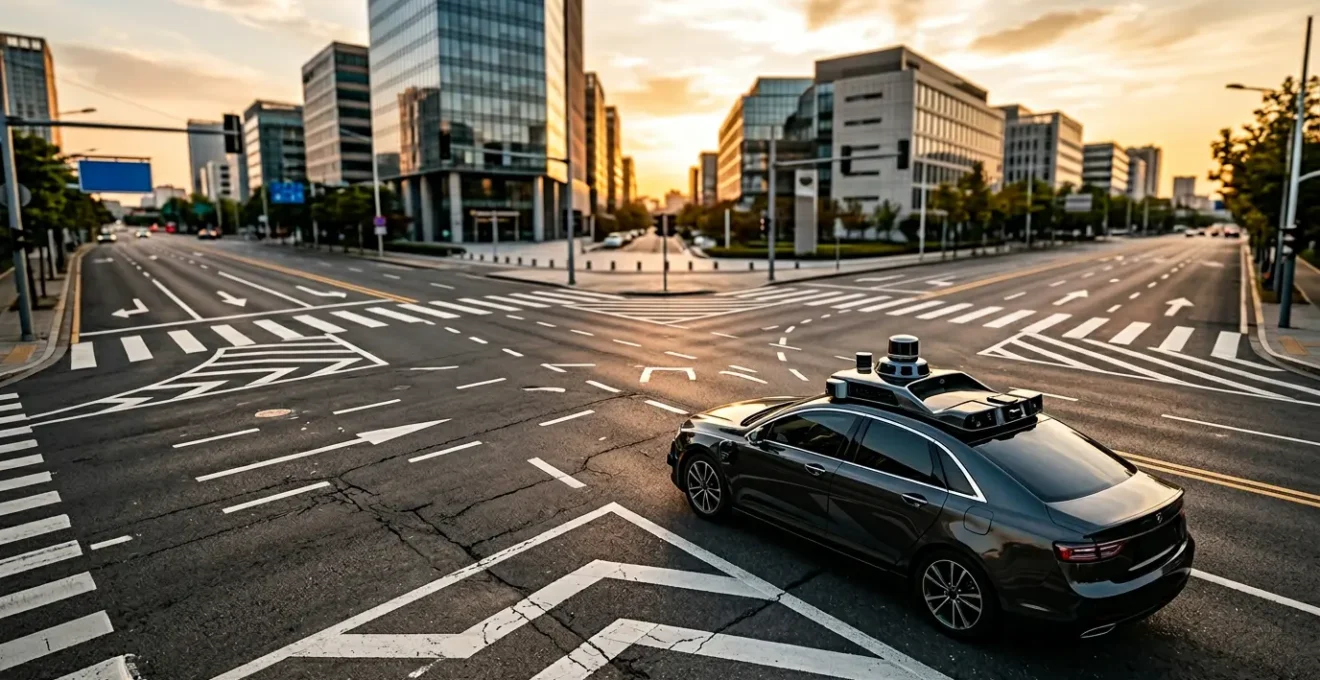
The debate over autonomous vehicle liability isn’t about solving the Trolley Problem; it’s about confronting the hidden vulnerabilities in the technology itself.
- Algorithmic bias, external sensor manipulation, and opaque data ownership are the true legal and financial battlegrounds defining fault.
- Liability is not simply shifting from driver to manufacturer but is diffusing into a complex “liability vacuum” involving multiple parties.
Recommendation: Policymakers and insurers must shift focus from programming universal ethics to creating resilient frameworks for these new, complex points of failure.
When an autonomous vehicle is involved in a collision, the immediate and seemingly simple question is: who is liable? For decades, the answer in automobile accidents has been relatively straightforward, centering on driver error. However, as control shifts from human hands to silicon processors, the legal and ethical landscape becomes profoundly more complex. The conversation is often dominated by philosophical thought experiments, most famously the “Trolley Problem,” which forces a binary choice between two tragic outcomes. This forces us to ask if a car should be programmed to sacrifice its occupant to save a group of pedestrians, or vice versa.
Yet, fixating on this ethical dilemma, while intellectually stimulating, dangerously oversimplifies the reality of autonomous liability. It presumes that fault can be neatly programmed and assigned. The truth is far murkier. The real battlegrounds for determining responsibility lie not in pre-ordained ethical frameworks but in the unseen technical vulnerabilities and legal grey areas that riddle the technology. The critical questions are not just about the car’s final decision, but about the integrity of the systems that informed it. Was its perception of the world manipulated? Was its decision-making algorithm inherently biased? And who, after the fact, has the right to access the data that holds the answers?
This exploration moves beyond the Trolley Problem to dissect the true nature of autonomous liability. We will investigate why a universal ethical code is a functional impossibility, how critical crash data is accessed, and how the very sensors a car relies upon can be deceived. By examining these deep-seated issues, we reveal a “liability vacuum” where responsibility is not merely transferred but fractured, creating unprecedented challenges for insurers, policymakers, and the public alike. This journey will clarify how these shifts impact everything from insurance premiums to the very feasibility of our automated future.
Summary: Decoding the True Cost and Culpability in Autonomous Vehicle Incidents
- Why Programming Ethics into Cars Is Impossible to Standardize?
- How to Access “Black Box” Data After an Autonomous Vehicle Crash?
- The Laser Trick That Confuses Self-Driving Cars into Stopping
- How Will Liability Shifts Impact Your Auto Insurance Cost?
- Level 5 Autonomy: Why Are We Still 10 Years Away?
- The Airspace Management Error That Could Ground Your Fleet
- Why Algorithms Deny Loans to Certain Demographics More Often?
- Drone Delivery: Is It Legally Feasible for Your Local Business Yet?
Why Programming Ethics into Cars Is Impossible to Standardize?
The notion of creating a single, universal ethical code for autonomous vehicles collapses under the weight of human diversity. What is considered a “moral” decision in one culture is not necessarily viewed the same way in another. This isn’t a matter of speculation; it’s a conclusion drawn from extensive global research. The core challenge is that ethics are not a fixed set of logical rules but a fluid, culturally dependent construct. A manufacturer cannot program a car to satisfy global ethical expectations because those expectations are fundamentally contradictory.
This was starkly illustrated by MIT’s groundbreaking Moral Machine experiment, which gathered 40 million moral decisions from 233 countries. The study revealed deep-seated cultural dissonance. For example, participants from individualistic cultures, like those in North America and Europe, showed a strong preference for sparing the young over the old. In contrast, participants from collectivist cultures, such as Japan and China, showed a much weaker preference, prioritizing the group over individual characteristics. These differences create an impossible dilemma for automakers seeking to sell the same vehicle globally: whose ethics do you program into the car?
As Iyad Rahwan, a lead researcher on the project, noted, this exposes a fundamental flaw in the pursuit of a perfect algorithm. He states:
People who think about machine ethics make it sound like you can come up with a perfect set of rules for robots, and what we show here with data is that there are no universal rules.
– Iyad Rahwan, MIT Media Lab research on Moral Machine
This lack of a universal standard means that any programmed ethical choice will inevitably be seen as unethical by a significant portion of the global market. Consequently, the search for liability cannot be resolved by simply auditing the code against a non-existent ethical gold standard. It forces the legal system to grapple with the concept of algorithmic culpability in a world with no moral consensus.
How to Access “Black Box” Data After an Autonomous Vehicle Crash?
In the aftermath of a crash, establishing liability hinges on one critical element: evidence. For modern vehicles, this evidence is stored in an Event Data Recorder (EDR), or “black box.” While virtually all new cars are equipped with an EDR, accessing its contents is the first major battle in the new landscape of automotive litigation. The data within—capturing everything from speed and braking to the status of advanced driver-assistance systems (ADAS)—is the key to reconstructing an incident. However, this data is not public property.
The legal framework surrounding EDRs creates a complex data custody chain. Ownership of the data is a contentious issue, with claims from the vehicle owner, the manufacturer (OEM), and even the software provider. Access is tightly regulated by a patchwork of state and federal privacy laws. As legal experts from SSP Vehicle Litigation Services clarify, retrieving the data typically requires either the explicit consent of the vehicle owner or a court order. This process can be slow and adversarial, particularly when the data may incriminate the very party being asked to provide it.
This challenge is magnified with the rise of autonomous systems. OEMs often consider the vehicle’s operational data proprietary, treating it as a trade secret. They control not only the data itself but also the proprietary tools required to download and interpret it. This creates an information asymmetry where the entity potentially at fault is also the gatekeeper of the primary evidence. For insurers and legal professionals, navigating this opaque system to prove or disprove fault becomes a formidable task, shifting the focus from the facts of the crash to the legal battle for data access.
Action Plan: Your Post-AV Crash Data Access Checklist
- Preservation of Evidence: Immediately instruct the owner not to drive the vehicle and prevent any repairs or data overwrites. Document the state of the vehicle and the crash scene.
- Identify the Data Holder: Determine who controls the data—the owner, the OEM, a telematics provider, or the ADAS software company.
- Secure Legal Consent: Obtain written consent from the vehicle owner for data retrieval. If consent is withheld or the OEM is the target, prepare for legal action.
- Engage a Forensic Expert: Hire an expert with the specific hardware and software tools certified to download and analyze EDR data from the particular vehicle model.
- Formal Request and Subpoena: Issue a formal request for data preservation to the OEM and, if necessary, file a motion to compel or issue a subpoena to secure access to the full dataset.
The Laser Trick That Confuses Self-Driving Cars into Stopping
The liability question assumes a vehicle is operating with accurate information. But what if a car’s perception of reality can be maliciously altered? Research has exposed a critical vulnerability in the very sensors that autonomous vehicles use to “see” the world, particularly LiDAR (Light Detection and Ranging). This introduces a terrifying new variable: external sabotage. The integrity of a car’s sensors is not guaranteed, and attacks can be surprisingly simple to execute.
Engineers have demonstrated that it’s possible to create “ghosts” in a car’s vision—making it perceive obstacles that aren’t there. By firing precisely timed laser pulses at a vehicle’s LiDAR sensor, an attacker can spoof the signal and fool the system into thinking an object is directly in its path. This can cause the car to brake suddenly and dangerously in flowing traffic or even swerve off the road. The effectiveness of this method is alarming; University of Michigan security researchers demonstrated black-box spoofing attacks achieving an 80% mean success rate across various target models.
Case Study: The Portable LiDAR Spoofing Device
Researchers at the University of Michigan and the University of Electro-Communications in Japan developed a proof-of-concept attack using a simple, portable device made from a battery, a small logic circuit, and an infrared laser. By aiming this device at a moving autonomous vehicle, they could reliably trigger its emergency braking system by creating the illusion of a pedestrian or stopped car. This “adversarial attack” requires minimal precision and exposes a fundamental flaw in sensor integrity. If a third party can force a crash, the traditional liability model, which looks for fault in the driver or manufacturer, becomes inadequate. It opens a liability vacuum where the true culprit is an anonymous attacker, leaving the vehicle’s owner and its insurer to grapple with the consequences.
This type of vulnerability shifts the legal focus from programming errors to hardware and software security. Is the manufacturer liable for not building a spoof-proof sensor? Is this a foreseeable criminal act that breaks the chain of causation? These questions have no easy answers and demonstrate that the technical stability of the car’s perception systems is a primary determinant of liability, far removed from abstract ethical choices.
How Will Liability Shifts Impact Your Auto Insurance Cost?
The transition to autonomous driving fundamentally re-engineers the auto insurance market. For a century, insurance has been built around a model of individual driver risk. Premiums are calculated based on personal driving history, age, and other human factors. As automation removes the human from direct control, this model becomes obsolete. The risk profile no longer belongs to the driver but to the machine and its creators.
This precipitates a monumental shift from personal auto liability to product liability. When a crash is caused by a software glitch, a sensor failure, or an algorithmic bias, the fault lies with the product’s design, manufacturing, or programming. Insurers, therefore, will increasingly be covering the risk of the manufacturer, not the driver. As analysts at Swept AI succinctly put it, “As liability shifts from drivers to manufacturers, autonomous vehicle insurance shifts from personal auto to product liability.” This is not a minor adjustment; it’s a structural transformation of the industry.
The financial implications are immense. A comprehensive analysis by KPMG predicted this seismic change, suggesting the personal auto insurance sector could shrink by over 40% as product liability takes its place. Specifically, KPMG’s ‘Marketplace of Change’ white paper projects that personal auto liability’s share of total auto losses will fall dramatically, while product liability for OEMs and software developers will surge. For consumers, this could mean lower personal premiums, but the costs will not simply disappear. They will be baked into the purchase price and maintenance costs of the vehicle, as manufacturers pass on their own massive insurance expenses. The total cost of mobility may not decrease, but will instead be redistributed in a far more complex and less transparent way.
Level 5 Autonomy: Why Are We Still 10 Years Away?
The promise of Level 5 autonomy—a vehicle that can operate anywhere, under any conditions, without human intervention—has proven far more elusive than early predictions suggested. While the technology has made incredible strides, the remaining hurdles are not merely technical; they are deeply rooted in the legal, regulatory, and infrastructural challenges that we have explored. The final few percentage points of reliability are exponentially harder to achieve and, more importantly, to legally certify.
The reality is that even high-level automation will remain a niche feature for the foreseeable future. Projections from industry analysts temper the hype with a dose of realism. For instance, S&P Global Mobility projects that by 2035, fewer than 6% of new vehicles sold worldwide will have Level 4 automation. Level 5 is not even on the commercial horizon. The primary barrier is the prohibitive nature of liability. As legal scholars Marchant and Lindor argued, even if an AV is statistically safer than a human, the shift in responsibility from millions of individual drivers to a handful of corporate manufacturers creates a concentrated legal and financial risk that may be too great to bear.
This is the crux of the issue: for a manufacturer to assume 100% of the liability, they must have 100% confidence in their system’s ability to handle every conceivable “edge case”—from bizarre weather phenomena and unpredictable human behavior to the adversarial attacks discussed earlier. This is a near-impossible standard. As a result, the industry is stuck in a state of advanced driver-assistance, where the human is still legally required to be the ultimate backstop. The move to full, unattended autonomy requires a resolution to the liability vacuum, a challenge that is proving far more difficult than teaching a car to drive.
The Airspace Management Error That Could Ground Your Fleet
While autonomous cars navigate our roads, a parallel revolution is happening in the skies with unmanned aerial vehicles (UAVs), or drones. The challenges of managing a fleet of autonomous ground vehicles offer a powerful analogy for the future of automated logistics. Just as a single software flaw can have cascading effects on a fleet of connected cars, an error in airspace management could instantly ground an entire fleet of delivery drones. This introduces the concept of systemic liability, where a single point of failure in a centralized control system can lead to widespread failure.
Traditional liability frameworks are ill-equipped for this new reality. As legal analysis from WSHB Law points out, “Traditional liability frameworks were designed for vehicles controlled by human drivers, but AVs blur the lines between human error and technological malfunction.” This blurring is even more pronounced in fleet operations. Imagine a scenario where a faulty update to a traffic management protocol for AVs causes a city-wide gridlock of stopped vehicles. Who is liable? The OEM? The network provider? The municipal authority that approved the protocol? The fault is no longer isolated to a single vehicle but is distributed across an entire digital ecosystem.
This parallel with aviation is instructive. The stringent regulations governing air traffic control exist precisely to prevent systemic failures. For autonomous vehicles, both on the ground and in the air, a similar framework for managing their “digital airspace”—the complex web of V2X (Vehicle-to-Everything) communication, network security, and software updates—is desperately needed. Without it, a single management error could have consequences far beyond a single accident, posing an existential risk to any business reliant on an automated fleet.
Why Algorithms Deny Loans to Certain Demographics More Often?
The title of this section, concerning loan applications, points to a broader and more insidious problem in automation: inherent algorithmic bias. An algorithm is only as unbiased as the data it’s trained on. When historical data reflects societal biases, the AI learns and perpetuates them, often at a scale and with an opacity that makes them difficult to challenge. This issue of algorithmic culpability extends directly to autonomous vehicles, where the code’s “worldview” can create discriminatory risk profiles.
For example, if an AV’s recognition system is trained predominantly on data from one demographic, it may be less effective at identifying and reacting to individuals from another. This isn’t a hypothetical concern. Research has demonstrated that commercial AI systems can be systematically flawed.
Case Study: Adversarial Attacks and Learned Bias
Research on adversarial attacks demonstrated how AI could be tricked into misreading a stop sign as a speed limit sign. This reveals a deeper problem: the AI’s decision-making process is a “black box” that can develop patterns not anticipated by its creators. If an AI system, through its training data, learns to associate certain neighborhoods or demographics with higher-risk driving behavior, it might adopt a more aggressive or hesitant driving style in those areas. This creates a discriminatory safety standard, where the vehicle is inherently less safe for certain populations. Determining liability for such a “programmed” bias is a legal minefield, raising questions about the manufacturer’s due diligence in sourcing and cleaning their training data.
Furthermore, this technological opacity can be met with human bias in the courtroom. As legal analysts at WSHB have noted, “Jurors may exhibit bias against AVs… holding them to a higher standard than human drivers.” The fear and skepticism surrounding complex AI could lead juries to assign fault to the machine even when a human driver in the same situation would have been exonerated. The combination of inherent algorithmic bias and potential juror bias creates a volatile and unpredictable liability environment for manufacturers.
Key Takeaways
- Liability is not simply shifting from driver to manufacturer but is fracturing into a complex “liability vacuum” involving multiple actors and new types of fault.
- The pursuit of a universal, programmable ethical code is a fallacy due to fundamental, data-proven differences in cultural moralities.
- True liability will be determined by technical vulnerabilities, including the security of sensors (sensor integrity), the bias embedded in algorithms (algorithmic culpability), and the legal control over crash data (data custody chain).
Drone Delivery: Is It Legally Feasible for Your Local Business Yet?
The complex web of liability we’ve untangled for autonomous cars serves as a direct blueprint for the next wave of automation: commercial drone delivery. The question of legal feasibility for a local business to deploy drones is not merely about FAA regulations; it is fundamentally a question of unresolved liability. All the issues facing self-driving cars—ethical programming, data ownership, sensor security, and algorithmic bias—will be inherited by the autonomous aviation industry.
The stakes are enormous, as evidenced by the market that autonomous systems are set to disrupt. In 2023 alone, the Department of the Treasury reported that personal auto insurance premiums were worth $318 billion in the U.S. As this market transforms, the same questions of product vs. personal liability will arise for drones. If a delivery drone crashes due to a GPS spoofing attack or a software glitch, who pays for the damage? The business that owns it? The drone manufacturer? The provider of the fleet management software? The power of OEMs in this new world cannot be understated. As Swept AI notes, manufacturers often control the proprietary vehicle data, giving them a competitive advantage and even allowing them to launch their own insurance products, further complicating the landscape.
Ultimately, the legal and insurance frameworks developed for autonomous cars will set the precedent for all autonomous systems. For a local business considering drone delivery, the answer to “is it feasible?” depends less on the technology’s capability and more on the maturity of the liability ecosystem. Without clear laws, affordable insurance products, and standardized procedures for incident investigation, the risk for early adopters may be too great. The core challenge remains the same: moving from a model of individual fault to one that can account for complex, systemic, and algorithmic failure.
For insurers, legislators, and manufacturers, the challenge is clear: to build a resilient legal and insurance framework that addresses these deep technological vulnerabilities before the next generation of automation takes flight.