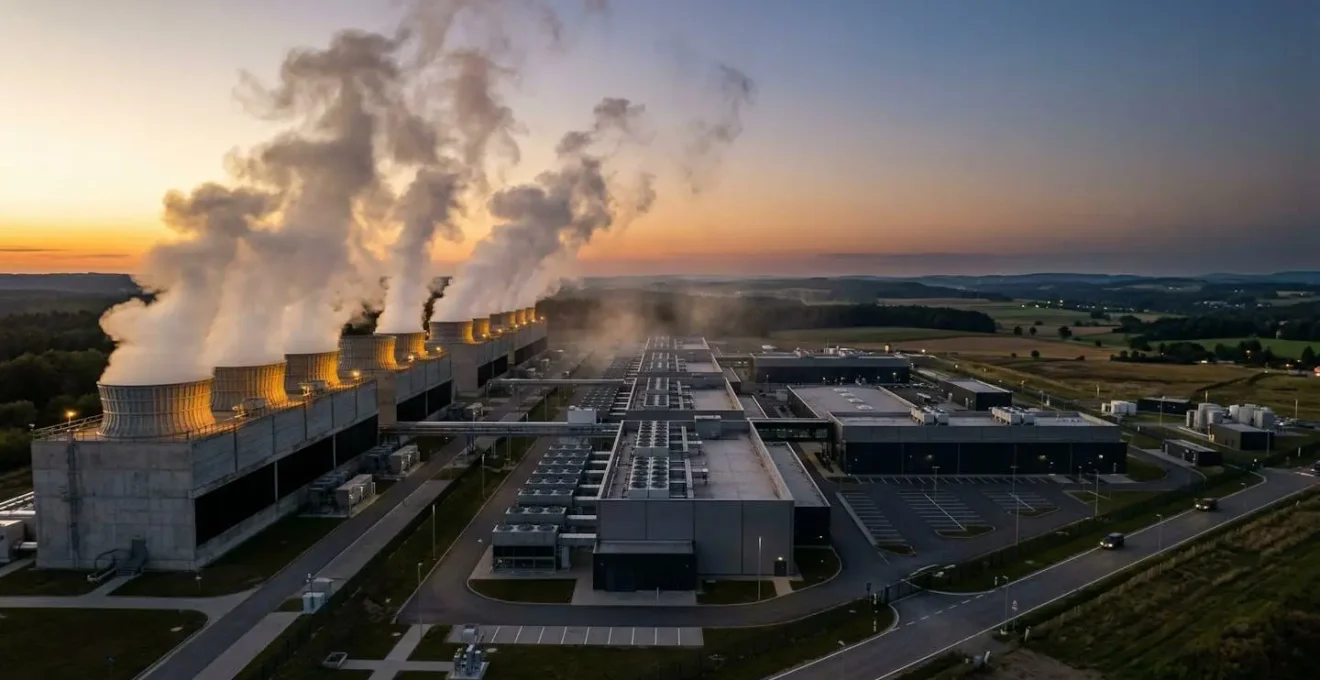
Contrary to its ethereal image, the ‘cloud’ is a massive, physical industry whose environmental impact—particularly in water consumption—is dangerously underestimated.
- Data centers consume vast quantities of freshwater for cooling, with AI training alone requiring hundreds of thousands of liters for a single model.
- Storing data isn’t passive; every gigabyte requires continuously powered and cooled servers, contributing a significant, ongoing carbon footprint.
Recommendation: Scrutinize your cloud provider’s environmental reports for actual water usage and 24/7 carbon-free energy matching, not just carbon-neutral claims based on offsets.
We think of the cloud as an invisible, weightless realm where our data lives. We upload photos, stream movies, and save documents with the implicit belief that it all happens in an abstract digital space. This perception is a carefully constructed illusion. The common understanding is that data centers use a lot of electricity, an issue many tech giants claim to be addressing with renewable energy. But this narrative conveniently overlooks a far more tangible and alarming reality.
The truth is, the cloud has a massive physical body. It is a sprawling global network of millions of servers housed in colossal factory-like buildings, all demanding constant power, intensive cooling, and, most surprisingly, enormous volumes of water. The comparison to the aviation industry is not hyperbole; it is a wake-up call. While aviation’s emissions are visible in the sky, the cloud’s environmental cost is hidden behind a veil of marketing and technical abstraction.
But what if the true measure of the cloud’s impact isn’t just about carbon, but about the very water we drink? The central argument of this investigation is that the digital world’s thirst is creating a physical resource crisis. This isn’t a problem of the future; it’s happening now, in drought-stricken regions that also happen to be data center hubs. We must shatter the myth of the ethereal cloud and confront its digital materiality—the tangible, resource-intensive footprint of every byte we store.
This article will dissect the hidden environmental costs of our digital lives. We will explore the shocking water consumption of data centers, explain how to see through greenwashing claims, and reveal why simply deleting old files is one of the most effective environmental actions you can take. It is time to understand the physical weight of our data.
To navigate this critical topic, we have structured our analysis into several key areas. The following summary outlines the journey we will take to uncover the true environmental cost of the cloud and empower you to make more sustainable digital choices.
Summary: Uncovering the Cloud’s True Environmental Footprint
- Why Water Usage in Data Centers Is Causing Drought Concerns?
- How to Select a Cloud Provider That Uses 100% Renewables?
- The “Delete” Problem: Why Keeping Old Emails Hurts the Planet?
- Virtualization: How to Run More Apps on Fewer Physical Servers?
- Iceland vs Virginia: Why Data Center Location Matters for Energy?
- Y2Q: The Countdown to the “Quantum Apocalypse” Explained
- Why GaN Chargers Are 40% Smaller Than Traditional Ones?
- Why Carbon-Neutral Tech Claims Are Often Greenwashing?
Why Water Usage in Data Centers Is Causing Drought Concerns?
The most shocking secret of the cloud is not its energy use, but its thirst. Data centers generate immense heat, and the primary method of cooling them involves evaporative cooling towers that consume and evaporate vast quantities of freshwater. This places a direct and often unsustainable strain on local water supplies, particularly in the arid regions where many data centers are built. This direct competition for a life-sustaining resource is a stark example of digital materiality, where our virtual activities have a direct physical consequence on the environment.
The scale of this consumption is staggering. In 2023, U.S. data centers consumed an estimated 17 billion gallons of water directly for cooling. The rise of artificial intelligence is dramatically accelerating this trend. For instance, research from the University of California, Riverside shows that training the GPT-3 model alone in Microsoft’s U.S. facilities consumed approximately 700,000 liters of clean freshwater. As AI models grow in complexity, this “water footprint” is set to explode, pitting the tech industry’s growth against community water security.
This image captures the very essence of the problem: the physical transition of precious liquid water into atmospheric vapor, all to cool the machines that hold our data. This constant resource drain is not a byproduct; it is a core function of the cloud’s infrastructure. When a data center is built near a community already facing water scarcity, the ethical implications become impossible to ignore. The “invisible” cloud suddenly becomes a very visible competitor for a finite resource, raising urgent questions about corporate responsibility and the true cost of our digital dependency.
How to Select a Cloud Provider That Uses 100% Renewables?
Confronted with their massive energy footprint, all major cloud providers now make bold claims about being “100% renewable” or “carbon neutral.” However, these statements often mask a more complex reality. The key to genuine sustainability lies not in marketing claims, but in understanding the methodology behind them. Many providers rely on Renewable Energy Certificates (RECs), which allow them to claim carbon neutrality on paper by purchasing “green credits” while their data centers continue to draw power from a fossil-fuel-heavy grid.
A far more meaningful and transparent approach is 24/7 carbon-free energy (CFE). This is the gold standard, aiming to match a data center’s electricity consumption with clean energy production from the same regional grid, every hour of every day. As the Google Cloud Sustainability Team notes, this involves actively investing in local renewable projects to ensure real-world, real-time decarbonization. This commitment moves beyond simple carbon accounting and represents a true investment in transforming the energy grid itself.
To make an informed choice, businesses and consumers must look past the headlines and investigate the details. The following table highlights the different commitments of major cloud providers, revealing the crucial distinctions in their approaches to renewable energy.
| Cloud Provider | Renewable Energy Commitment | Achievement Year | Method |
|---|---|---|---|
| AWS (Amazon) | 100% renewable energy match | 2024 (achieved) | Renewable Energy Certificates + PPAs |
| Google Cloud | 24/7 carbon-free energy | 2030 (target) | Hourly matching + local PPAs |
| Microsoft Azure | Carbon negative + 100% renewable | 2030 (target) | RECs + carbon removal offsets |
| Oracle Cloud | 100% renewable (EU & LATAM) | Achieved in select regions | Regional renewable sourcing |
Your Action Plan: Auditing a Cloud Provider’s Green Credentials
- Check for 24/7 CFE: Prioritize providers who publish hourly data on carbon-free energy matching, not just annual REC purchases.
- Analyze Water Usage Reports: Look for a Water Usage Effectiveness (WUE) metric and transparency on water sources, especially in water-stressed regions.
- Verify PPA Locations: Ensure their Power Purchase Agreements (PPAs) for renewables are located on the same grids as their data centers for real impact.
- Scrutinize “Carbon Negative” Claims: Investigate if these claims rely heavily on offsets and future carbon capture technology versus immediate emissions reduction.
- Demand Hardware Efficiency Data: Ask for reports on server fleet efficiency, use of custom silicon (like AWS Graviton), and virtualization density.
The “Delete” Problem: Why Keeping Old Emails Hurts the Planet?
Every file you store in the cloud, from a decade-old email to a blurry photo, has a physical weight. It exists on a spinning hard drive or solid-state disk inside a server that must be powered on, networked, and cooled 24 hours a day, 365 days a year. Data storage is not a one-time act; it is a continuous process of energy consumption. The “delete” button is therefore not just a tool for digital organization, but a powerful instrument for environmental impact reduction.
The cumulative effect of this “digital hoarding” is enormous. While a single email has a negligible footprint, the terabytes of forgotten data held by individuals and corporations require a massive, energy-intensive infrastructure to maintain. A Carnegie Mellon University study found that storing 100 gigabytes of data in the cloud for one year has a carbon footprint of approximately 0.2 tons of CO2. When scaled up, industry analysis reveals that storing just one terabyte of data can have an annual footprint of 2 tonnes of CO2. This is the energy cost of inaction.
Thinking about this accumulated data offers a tangible way to reduce your personal and organizational environmental impact. By actively and regularly deleting unnecessary files, you reduce the overall demand on data centers. This concept, the Deletion Dividend, represents the real-world energy and resource savings realized from digital cleanup. It reframes data deletion from a simple chore into a meaningful act of digital conservation. The less data the world needs to store, the fewer servers are needed, the less energy is consumed, and the less water is required for cooling. It’s a direct and empowering way to lighten the cloud’s physical load on the planet.
Virtualization: How to Run More Apps on Fewer Physical Servers?
One of the most powerful tools for reducing the cloud’s environmental impact is a technology that has been at its core from the beginning: virtualization. In simple terms, virtualization allows a single physical server to act as multiple, independent “virtual” servers. Instead of needing one physical machine for your email, another for your website, and a third for your database, all can run securely and efficiently on a single, more powerful piece of hardware. This principle of consolidation is fundamental to the efficiency of modern cloud computing.
The environmental benefit is direct and profound: a smaller infrastructure footprint. By dramatically increasing the density of applications per physical server, virtualization reduces the total number of servers required. This leads to a cascade of savings: less energy consumed by the servers themselves, less energy required for cooling the data center, and even a smaller physical building needed to house the hardware. It is the technological embodiment of “doing more with less.”
This efficiency is most pronounced in modern “hyperscale” data centers operated by major cloud providers. These facilities are designed from the ground up to maximize virtualization and operational efficiency. The impact is significant; according to a report from the Lawrence Berkeley National Laboratory, if the entire cloud computing industry shifted to these highly efficient hyperscale facilities, overall energy usage could drop by as much as 25 percent. This highlights that how we structure our digital infrastructure is as important as how we power it. Optimization and efficiency are key levers in mitigating the cloud’s environmental toll.
Iceland vs Virginia: Why Data Center Location Matters for Energy?
The phrase “the cloud” suggests a placeless, ubiquitous entity. The reality is that your data resides in a specific building in a specific location, plugged into a specific regional electricity grid. This geographical fact is one of the most critical and overlooked factors in a data center’s environmental impact. A data center built in a region powered predominantly by coal will have a dramatically higher carbon footprint than an identical facility in a location rich with geothermal, hydro, or wind power.
Northern Virginia’s “Data Center Alley” is a prime example of this challenge. It is the largest concentration of data centers in the world, and its immense power demand puts a significant strain on a grid that still relies heavily on fossil fuels. According to IEA analysis, data centers in this single region already account for a substantial portion of total electricity consumption. This creates a feedback loop where the growth of the digital economy directly drives fossil fuel consumption.
In stark contrast, strategic location choices can yield massive environmental benefits. Google’s data center in Finland is a powerful case study. The facility leverages a regional grid abundant in nuclear, hydropower, and wind energy. By combining this clean grid mix with its own renewable energy contracts, the data center frequently achieves over 90% carbon-free energy on an hourly basis. Some locations, like Iceland, offer a near-perfect environment, with 100% renewable geothermal and hydroelectric power and a naturally cold climate that drastically reduces the need for artificial cooling. This demonstrates that choosing where to place data centers is not just a logistical decision, but a fundamental environmental one.
Y2Q: The Countdown to the “Quantum Apocalypse” Explained
As we look to the future of computing, the rise of quantum machines promises to solve problems currently considered impossible. This technological leap, often discussed in the context of “Y2Q” or the “Quantum Apocalypse” due to its potential to break current encryption standards, is seen as the next great frontier. However, from an environmental perspective, this new frontier comes with its own immense resource challenges. The assumption that future technology will inherently be more efficient is a dangerous one.
The physical reality of today’s quantum computers is a testament to the concept of resource drain. These machines are not sleek, room-temperature devices; they are complex apparatuses that require extreme operating conditions. As a leading analysis of quantum computing’s energy demands highlights, “Current quantum computers are incredibly energy-intensive due to their extreme cryogenic cooling requirements near absolute zero, making their energy-per-calculation astronomically high.”
This need for cryogenic cooling represents a massive energy barrier. While the computational power is immense, the energy needed to create and maintain the near-absolute-zero environment for the quantum bits (qubits) is orders of magnitude greater than for traditional servers. This serves as a critical reminder that even the most advanced digital technologies are bound by the laws of physics and have a tangible, physical cost. As we plan for a quantum future, we must simultaneously engineer solutions not just for its computational power, but also for its environmental footprint, lest we solve one set of problems while creating a new energy crisis.
Why GaN Chargers Are 40% Smaller Than Traditional Ones?
The push for greater energy efficiency is not confined to the massive scale of data centers; it extends to the very components that power our digital world. On a consumer level, Gallium Nitride (GaN) chargers are a perfect example. By using a more efficient semiconductor material than traditional silicon, they can deliver the same amount of power in a much smaller, cooler package. This principle—achieving the same or better performance with less energy waste and a smaller physical form factor—is the holy grail of sustainable technology.
This exact same principle of hardware efficiency is exponentially more critical inside data centers. A small efficiency gain, when multiplied across hundreds of thousands of servers, translates into enormous energy savings. This is why cloud providers are in a race to design their own custom, hyper-efficient silicon. A leading example is Amazon’s Graviton processor. By designing a chip specifically optimized for cloud workloads, they achieve remarkable performance-per-watt gains.
The results are substantial. According to Amazon, their AWS Graviton-based instances use up to 60% less energy for the same performance compared to equivalent instances running on traditional processors. This is not an incremental improvement; it is a step-change in data center efficiency. It demonstrates that innovation at the micro-level of chip design can have a macro-level impact on the cloud’s overall energy consumption, directly reducing the need for power and, by extension, cooling and water.
Key Takeaways
- The cloud is a physical industry: Data centers consume vast amounts of tangible resources like water and land, not just electricity.
- Data has weight: Storing unused files requires continuous energy for power and cooling, making deletion a meaningful environmental action.
- “Carbon neutral” is not enough: True sustainability requires 24/7 matching of energy use with clean power on the same grid, not just paper offsets.
Why Carbon-Neutral Tech Claims Are Often Greenwashing?
The term “carbon neutral” has become a ubiquitous marketing buzzword in the tech industry. While it sounds impressive, it often serves as a form of greenwashing, creating a misleading perception of environmental responsibility. The primary mechanism for this is the use of Renewable Energy Certificates (RECs). A company can continue to power its data centers with electricity from a fossil-fuel-heavy grid, and then “offset” those emissions by purchasing RECs from a wind or solar farm located hundreds or thousands of miles away. The money changes hands, but the actual data center’s electricity is still dirty.
As one analysis from a climate intelligence platform bluntly states, this practice “does not reduce emissions in a meaningful way.” The core issue lies in the difference between Carbon Accounting and Carbon Reality. Market-based accounting, which uses RECs, allows a company to report zero emissions on paper. In contrast, location-based accounting measures the actual carbon intensity of the local grid powering the facility, reflecting the true emissions. The most honest method, 24/7 Carbon-Free Energy, takes this a step further by matching clean energy generation to consumption on an hourly basis.
This distinction is crucial for anyone serious about sustainability. The following table breaks down these accounting methods, revealing how easy it is to create a green illusion.
This comparative analysis from Climatiq’s breakdown of cloud carbon claims clarifies the vast difference between on-paper accounting and real-world impact.
| Accounting Method | What It Measures | Accuracy | Common Issues |
|---|---|---|---|
| Market-Based (RECs) | Purchased renewable energy certificates and contracts | Low – can show zero emissions despite fossil fuel use | Greenwashing potential, offsets don’t match actual grid consumption |
| Location-Based (Grid Mix) | Actual carbon intensity of local electricity grid | High – reflects real emissions from grid power | Doesn’t account for corporate renewable investments |
| 24/7 Carbon-Free (Hourly Matching) | Time-matched renewable energy on same grid | Highest – matches consumption with clean generation hourly | Complex to implement, limited availability |
Now that you are equipped with the knowledge to see past the marketing, the power shifts back to you. By understanding the true physical and environmental costs of the cloud, you can begin to make conscious choices, demand transparency from your providers, and advocate for a digital world that is genuinely sustainable, not just conveniently labeled as such.